Abstract
The knee is certainly one of Muay Thai‘s strongest and versatile close-range weapons — however like all close-range methods, its effectiveness relies upon completely on how properly it’s arrange. Touchdown a clear knee requires the power to shut distance safely, place the physique on the proper angle, and create the second of vulnerability that makes the strike potential. This text covers the three main strategies for establishing the Muay Thai knee: the clinch, which mixes footwork and postural management to create essentially the most dependable knee-landing atmosphere; footwork and angle-cutting used exterior the clinch to shut distance and create offensive positions; and strikes used to distract, occupy, and misdirect the opponent’s guard earlier than the knee arrives. Every methodology is explored with particular set-up variations — from clinch footwork and the break timing, to angle-cutting leg kicks, double jabs, and the total vary of leaping and switch-step knee variations. As Muay Thai World Champion and Evolve MMA teacher Chaowalit Jocky Fitness center places it, “The knee doesn’t rating as a result of it’s highly effective — it scores due to what comes earlier than it. Each nice knee in Muay Thai is the results of footwork, positioning, and timing that the opponent by no means absolutely noticed coming. Set it up accurately, and the knee takes care of itself.” Whether or not you’re a newbie exploring the knee for the primary time or a extra skilled fighter trying so as to add construction to your close-range recreation, this information provides you the instruments to make the knee a dependable weapon in your arsenal.
Key Takeaways
The knee is a close-range weapon that can not be used with out first closing distance, and the way you shut that distance determines whether or not the knee lands cleanly or will get countered. Footwork, angles, and hand positioning on the method are what make the knee obtainable, not the strike itself.
The clinch is essentially the most dependable atmosphere for touchdown knees as a result of it combines positional management with placing alternative. Dominant clinch positioning limits your opponent’s potential to reply whereas creating the area and angle wanted for the knee, making it more practical than making an attempt the identical strike from open vary.
Footwork exterior the clinch opens up knee alternatives that the clinch can not. Angle-cutting, full stepping, and distance manipulation every create totally different entries to the knee, and growing a wide range of these entries makes your knee recreation considerably more durable to learn and defend.
Strikes are essentially the most pure and accessible setups for inexperienced persons touchdown their first knees. A hook attracts the opponent’s guard to the facet, opening the centreline for a knee. A double jab occupies the arms and eyes when you shut the space. A leg kick forces an opponent to reposition, creating the timing window for a knee as they flip again into you.
Various the kind of knee, straight, angled, leaping, switch-step, or pop knee, multiplies the problem of defending in opposition to it. Every variation arrives from a distinct place and trajectory, and an opponent who has solely ever confronted straight knees up the center shall be considerably much less ready for a knee coming across the exterior or a leaping knee following a clinch break.
The timing of the clinch break is without doubt one of the most underused knee alternatives in newbie coaching. The second the clinch separates, each fighters are momentarily in transition, and a bounce knee or driving knee timed to that break arrives when the opponent’s defensive construction is at its least organised.
1) The Clinch
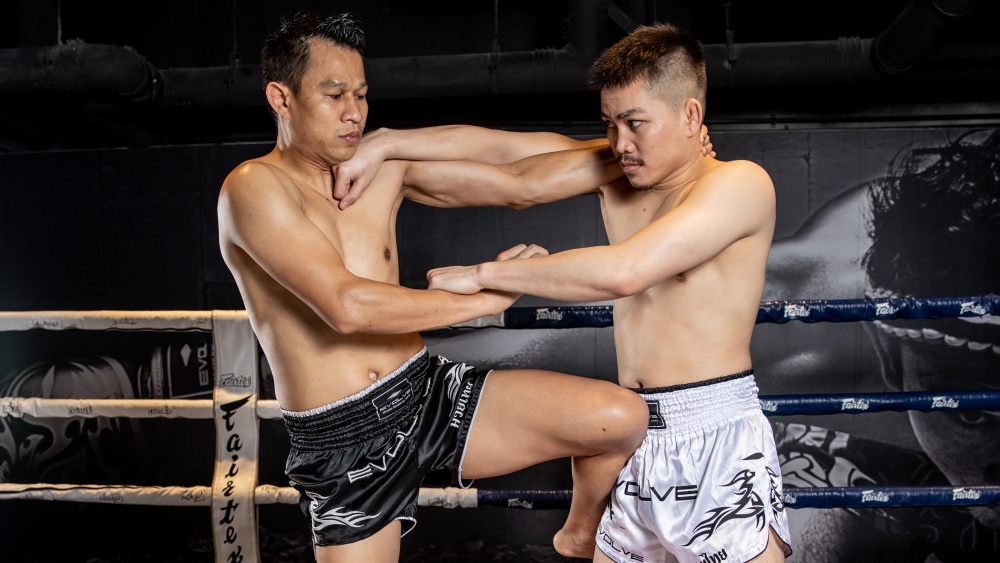
Probably among the best methods to make the most of and arrange the Muay Thai knee is throughout the clinch. The clinch lends fairly simply in direction of touchdown knees, and can allow you to make the most of each footwork and angles on the identical time to land highly effective knees. The management throughout the clinch creates a postural dominance that offers you area for touchdown the knee whereas sustaining management over your opponent. Attempt these set-ups from throughout the clinch to land your knees.
From throughout the clinch, attempt using footwork to maneuver your accomplice to a unique approach (consider taking a full step again, and turning to face the placement that was beforehand behind you whereas nonetheless sustaining the clinch). As your accomplice works to step and catch their steadiness, use that timing to land a knee to the physique. Each knees up the center and knees coming from the skin to your accomplice’s facet are efficient right here.
One other method to make use of the clinch is to make use of your footwork to step again whereas sustaining a strong clinch, pulling your accomplice with you, whereas nonetheless dealing with the identical course. As they step to observe you ahead, attempt driving again in with the knee up the center.
Make the most of the break of the clinch. When the clinch is about to interrupt, make the most of the timing of the break to drive in with a knee or perhaps a bounce knee to shut any distance that has been created.
2) Footwork
Footwork can be utilized to arrange the Muay Thai knee, each from throughout the clinch, as beforehand mentioned, or from exterior the clinch, as properly. Attempt these set-ups using footwork.
Use your footwork to chop an angle in your opponent earlier than stepping again into the knee. Slicing an angle will put you in a greater defensive place as you progress in direction of touchdown a knee. Attempt pulling your knee up and round your opponent versus a straight knee up the center. Make the most of your arms to put up or acquire some management of your opponent’s head or shoulder as you’re employed into this knee.
Use a full step to shut the space and land a knee up the center. Since knees require shut vary to be utilized, a full step will cowl that vary and get you nearer to your goal. If you’re transferring straight ahead utilizing a full step, make sure you make the most of your arms to guard your self, or by throwing a number of offensive strikes on the best way in direction of your opponent.
Use footwork to play with closing the space. Enjoying with other ways of transferring to the within with the knee will aid you to chop the space shortly, leaving you a bit extra protected throughout the course of. You’ve doubtless seen variations of “flying” knees in Muay Thai, and they’re enjoyable to play with and experiment with.
Attempt a wide range of knees, like a full-step knee (take a full step along with your again leg after which knee along with your lead knee), a bounce knee (again knee comes up, then jumps into the lead knee), a pop knee (each ft go away the bottom on the identical time and your again knee is utilized for the strike), or perhaps a switch-step knee (swap your ft concurrently, then throw the knee out of your again knee).
3) Strikes
Utilizing one strike to arrange one other is a good way to arrange any strike in Muay Thai. The knee is not any exception. Attempt using a few of these strikes to land knees:
Hooks: If you’re shut sufficient to throw a hook, then you’re shut sufficient to throw a knee. Attempt utilizing the hook (which comes from the facet) to arrange the knee (which can come from the entrance). Enjoying with strikes coming from totally different angles will aid you to distract your opponent and provides for one of the best alternative to land your strikes.
Leg kicks: Leg kicks are a good way to arrange your knees. Slicing an angle to land a leg kick will most at all times lead to your opponent turning again into you to take away your angle on them. Make the most of the second they flip again into you to drive your knee ahead in direction of your opponent.
Double Jab: Doubling (or extra) up your jab as you progress into your accomplice will hold their arms and eyes distracted as you give your self time to chop the space and observe up with a strong rear knee. Goal the jabs to the face as a way to draw your opponent’s arms as much as their face and open up the physique for touchdown your knees.
Whether or not you select to make the most of footwork, strikes, and even the clinch to carry every part collectively, the knee is a good strike to begin exploring with confidence as you bounce into Muay Thai.
Regularly Requested Questions About Setting Up The Muay Thai Knee
Q: Why Is The Knee Thought-about A Shut-Vary Weapon And How Does That Have an effect on How I Practice It?
A: The knee requires you to be inside roughly arm’s size of your opponent to land successfully — considerably nearer than punches or kicks, which may be thrown from a step or two exterior that vary. This proximity requirement implies that coaching the knee in isolation on a bag or in shadow is barely a part of the work. The extra essential coaching is growing the entries — the footwork, the clinch work, the strikes — that get you into knee vary safely with out being countered on the best way in. Newcomers who drill the knee strike itself with out drilling the approaches will discover that the approach works cleanly in drills however fails in sparring, as a result of the method has not been practised. Coaching the knee means coaching the total sequence from distance to contact.
Q: What Is The Distinction Between A Knee Thrown From The Clinch And A Knee Thrown From Open Vary?
A: From the clinch, you’ve gotten positional management over your opponent — your arms handle their posture, restrict their motion, and create area for the knee. This makes clinch knees extra dependable and extra highly effective, as a result of the opponent’s potential to maneuver away, examine, or counter is considerably decreased. From open vary, knees require a step or entry to shut the space, which creates a window of vulnerability throughout the method. Open-range knees compensate for this with shock and momentum — a bounce knee or a knee off a leg kick creates a distinct form of risk that the clinch can not replicate — however they require extra exact timing and extra assured method mechanics to land safely. Each have an essential place in a whole knee recreation.
Q: How Do I Keep away from Getting Countered When Stepping In For A Knee?
A: Closing the space for a knee with out getting countered requires a mixture of hand exercise, angle administration, and timing. Utilizing the arms to guard the pinnacle or occupy the opponent, throwing jabs, overlaying the centreline, on the best way in, reduces the window for clear counters. Slicing an angle relatively than transferring straight ahead means the opponent’s counter weapons usually are not pointed instantly at you as you arrive. Timing the method to a second when the opponent is dedicated to their very own motion, a kick, a mixture, a weight shift, takes them out of their optimum countering place. None of those components alone is adequate; the mix of all three is what makes the method genuinely secure.
Q: What Is The Most Efficient Knee Variation For Newcomers To Develop First?
A: The straight rear knee is essentially the most sensible start line for inexperienced persons as a result of its mechanics are essentially the most simple: weight ahead, hip drive up and thru the goal, lean the higher physique again for steadiness, and it’s the most naturally accessible from each the clinch and the full-step entry. As soon as the rear knee is clear and dependable, the straight lead knee from the clinch is the pure subsequent step. The extra dynamic variations, the bounce knee, the pop knee, and the switch-step knee, require higher steadiness, timing, and spatial consciousness, and are considerably extra rewarding to develop as soon as the elemental straight knee mechanics are strong. Speeding to the leaping variations earlier than the straight knee is dependable usually produces spectacular-looking however unreliable methods.
Q: How Does Slicing An Angle Earlier than A Knee Change What The Opponent Can Do Defensively?
A: Once you method straight down the centreline for a knee, the opponent is dealing with you instantly — their guard, their hips, and their potential to examine or counter are all optimally positioned to answer your assault. Once you minimize an angle first, you progress to a place the place the physique is not squarely dealing with you. From the skin angle, the knee arrives from a course that’s more durable to examine, their counter weapons level away from the place you’re, and their posture is momentarily compromised as they work to re-establish their dealing with. The angle-cut knee arriving across the exterior to the facet of the physique — relatively than straight up the center — is the particular mixture that takes most benefit of this positional disruption.
Q: Why Is The Clinch Break A Helpful Timing Window For The Knee?
A: When two fighters are within the clinch, and the maintain begins to separate — both as a result of a referee intervenes, as a result of one fighter pushes the opposite away, or as a result of the grip naturally loosens — each fighters are in a transitional state. Their arms are transferring from clinch place again towards their guard, their ft are adjusting to reestablish stance, and their defensive construction is momentarily at its least organised. A knee timed to fireplace exactly in the intervening time of the break — or a bounce knee that follows the separation — arrives when the opponent is least ready to examine or keep away from it and earlier than they’ve reset right into a strong defensive place. Creating the power to learn the break and hearth at that precise second is without doubt one of the higher-value timing expertise in close-range Muay Thai.
Q: Can Strike Setups For The Knee Work In opposition to Skilled Fighters Or Do They Solely Work On Newcomers?
A: The particular mechanics of how a strike units up the knee, a hook drawing the guard to the facet, a double jab occupying the arms when you shut distance, a leg kick forcing a repositioning — work in any respect ranges as a result of they exploit real biomechanical and attentional limitations, not inexperience. An skilled fighter whose guard has genuinely been drawn to the facet by a hook is in precisely the identical susceptible place as a newbie in the identical scenario. What modifications at increased ranges is that skilled fighters are higher at not being manipulated into these positions — higher at sustaining their guard throughout exchanges, higher at studying the leg kick setup, higher at recognising the double jab as a distance-closing device. The answer is to not abandon the setups however to make them much less readable — higher disguise, higher timing, extra diverse entries, and the endurance to make use of the setup solely when the opponent has genuinely been conditioned to anticipate the previous strike.
Q: How Do I Develop The Hand Management Wanted For Clinch Knees?
A: Hand management within the clinch — the power to handle the opponent’s arms, break their posture, and create area for the knee — is a ability that develops primarily by clinch-specific accomplice drilling relatively than placing drills. Start with cooperative accomplice drilling, the place each companions take turns establishing clinch positions and practising the footwork and postural management variations described on this article. As your understanding of the positions develops, introduce extra resistance — the place the accomplice actively works to take care of their posture and keep away from the knee — after which progress to stay clinch sparring. Particular drills like single-collar tie work, double-collar tie work, and arm-control entry sequences are essentially the most direct technique to develop the person parts of clinch hand management. The clinch is without doubt one of the most technically wealthy areas of Muay Thai, and the time invested in growing it pays dividends throughout each facet of your close-range recreation.
You may additionally like:
Final Information To The Muay Thai Knee Guard