
A survey of 1,145 UK park runners discovered that 570 of them have been coping with some kind of damage through the run itself.
From minor tweaks to gait-altering accidents, greater than half the runners have been making one of many main errors bodily therapists see most injured runners do.
Many of the different main errors sound smart: relaxation the damage utterly, stretch earlier than you run, roll out the calf that retains going tight.
However, these are largely based mostly on myths and running-specific bodily therapists want runners would cease doing them.
So, on this article we’re going to…
Element the 9 errors bodily therapists see runners take advantage of
What the analysis says about every
And change your method and what to do in another way
1. Operating Till the Ache Adjustments Your Stride
Operating by means of ache that alters your stride is the quickest method to flip one damage into two.
Once you limp to compensate for an present damage, you shift influence, loading, and pressure to a different space of the physique that isn’t designed to deal with that further work.
The second your stride modifications to guard one thing, the run is over and also you stroll dwelling.
Most runners maintain going as a result of they can not inform soreness from injury.
Delayed onset muscle soreness is uninteresting, spreads throughout an entire muscle group, reveals up on each legs, and eases as you heat up.
Damage ache is sharp, sits in a spot you possibly can cowl with one fingertip, often reveals up on one facet solely, and will get worse the longer you run.
The best way to Determine Whether or not to Begin At the moment’s Run
Run three checks earlier than you head out the door.
Press the sore space with one finger. A single level that makes you flinch, particularly over bone, means skip the run and e book an appointment.
Hop 10 instances on the sore leg. Ache on touchdown that you don’t really feel on the opposite leg factors to bone or joint involvement.
Run the primary 10 minutes at conversational effort. Ache that fades as you heat up is often secure to proceed, and ache that climbs means you cease.
The stride rule overrides all three checks: in case your gait modifications at any level, the run ends there.
2. Calling Complete Relaxation a Rehab Plan
Taking two full weeks off and anticipating the tissue to be stronger while you come again is the most typical rehab mistake in working.
Tendon, muscle, and bone construct capability in response to load.
Take away the load completely and also you restrict the physique’s means to adapt and while you return to working your muscle mass, tendons and bones are much less able to dealing with your previous mileage.
This has been examined straight in runners.
Researchers randomized 38 folks with Achilles tendinopathy into two teams.
One group saved working and leaping all through, held to a ache rule, and the opposite stopped all tendon-loading exercise for the primary six weeks.
Each teams tracked Achilles ache, stiffness, and the way a lot working the tendon tolerates and given a rating from 0 to 100. Each teams began at a rating of 57.
Twelve months later the runners who by no means stopped scored 85 and the remainder group scored 91, with no distinction between them in how shortly they recovered.
Six weeks of no working value these sufferers six weeks of coaching and purchased them no quicker restoration.
The best way to Hold Loading an Injured Tendon With out Making It Worse
That trial used a pain-monitoring rule you possibly can apply to most soft-tissue accidents.
Ache through the exercise can attain 5 out of 10. Beneath that line, maintain going. Above it, reduce the session quick.
Ache should settle by the following morning. Soreness nonetheless elevated 24 hours later means the load was too excessive.
Ache should not climb week to week. A steady or falling weekly ache rating means the development is working.
Confirmed bone stress accidents are the exception, they usually want protected weight bearing beneath a health care provider’s supervision earlier than any loading development begins.
3. Treating the Spot That Hurts
I injured runners rightly focus their major efforts on treating the realm that hurts.
However, most by no means transcend treating the signs producing the ache.
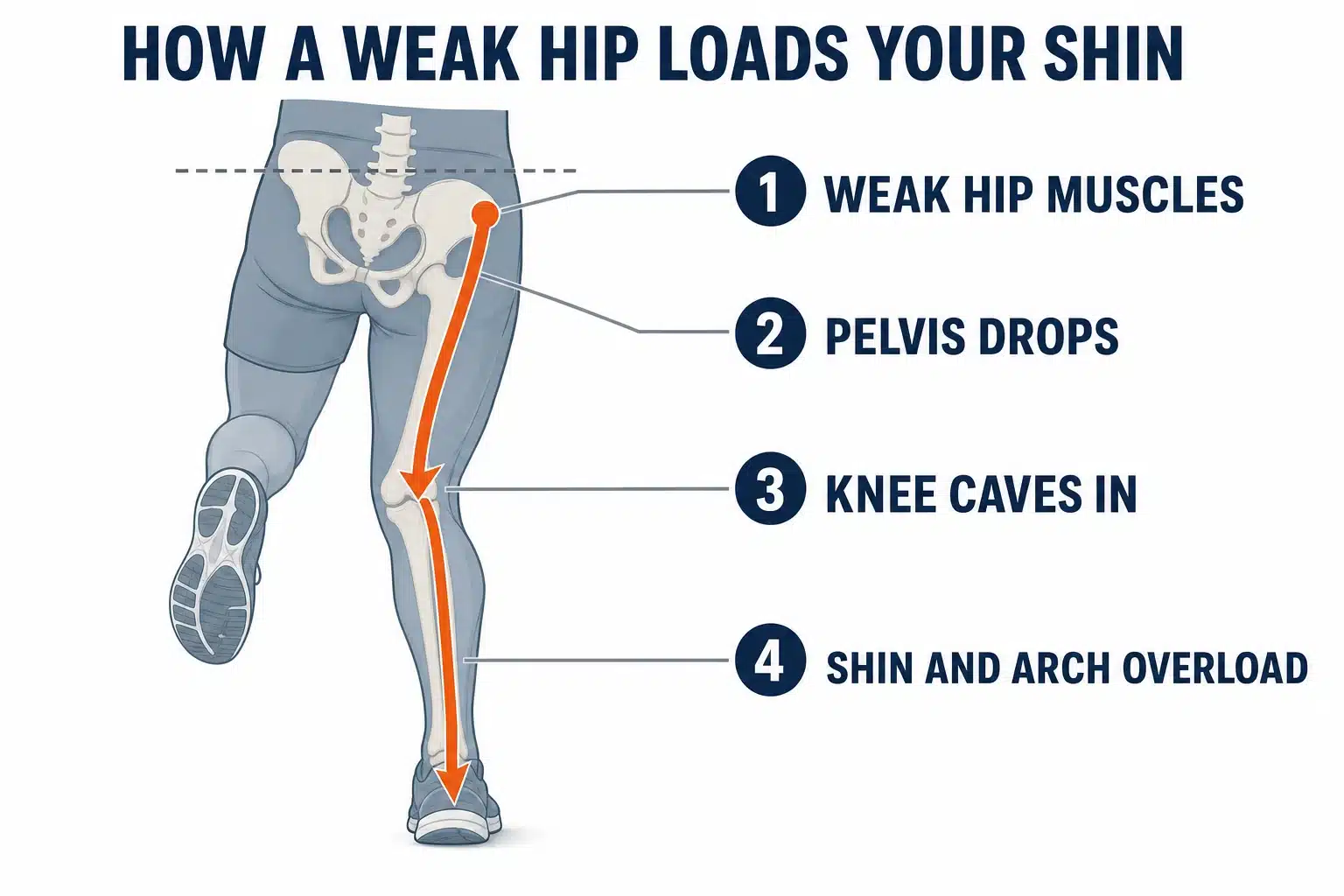
A calf that goes tight on one facet, an arch that aches, an outer knee that flares at mile 4: every is often a tissue absorbing forces a hip or a trunk failed to manage.
Weak point within the gluteus medius, the muscle on the surface of your hip that holds your pelvis degree, lets the pelvis drop on the swing facet with each step.
That drop tilts the knee inward and drives load down into the shin, the arch, and the surface of the knee.
The strongest proof for the place to place your energy work comes from a trial that in contrast two targets face to face.
In a 24-week trial of 325 runners, a hip and core program reduce the weekly prevalence of overuse accidents by 39%. A foot and ankle program in the identical trial produced no discount in any respect.
The hip and core group additionally had 52% decrease prevalence of the intense overuse accidents that cease you coaching altogether.
The best way to Discover the Hyperlink That’s Truly Failing
Three exams will present you the place the management is lacking, and also you solely want a mirror.
Single-leg squat, dealing with a mirror. Watch whether or not the knee drifts inward or the alternative hip drops. Evaluate left to proper.
Single-leg calf raises to failure. A distinction of greater than three or 4 reps between legs is a goal price engaged on.
Facet plank maintain, either side. A niche of greater than 15 seconds factors to trunk management that stops holding your pelvis degree beneath fatigue.
Load the weaker facet twice per week with single-leg deadlifts, step-downs, cut up squats, and loaded side-lying hip abduction.
4. Doing the Identical Three Rehab Workouts on the Identical Weight for Months
Clamshells with a crimson band, glute bridges, and a 30-second calf stretch will get you thru week one in every of rehab and nowhere close to week eight.
Operating already delivers hundreds of low-load muscle contractions per session, so extra low-load work provides little or no the game isn’t already offering.
What working doesn’t present is heavy loading, and heavy loading is the place the protecting impact lives.
A meta-analysis of six randomized trials protecting 7,738 athletes discovered that energy coaching reduce damage threat to roughly a 3rd of the management charge.
The identical evaluation discovered the impact was dose dependent: each 10% improve in energy coaching quantity dropped damage threat by greater than 4 proportion factors.
Extra load and extra quantity produced extra safety, with no ceiling recognized within the information.
The best way to Progress a Rehab Train Each Single Week
Transfer every train up one rung at any time when you possibly can end all of your units with two reps left within the tank.
Rung 1: each legs, body weight, managed tempo
Rung 2: each legs, body weight, three-second decreasing section
Rung 3: single leg, body weight
Rung 4: single leg with dumbbells or a loaded backpack
Rung 5: single leg, heavy, 4 to six reps the place the final rep is genuinely onerous
Two classes per week is the minimal that produced leads to the analysis.
Put these classes in your onerous working days so your straightforward days keep straightforward.
5. Utilizing Stretching as Your Damage Prevention Plan
Most runners have been taught that tight muscle mass trigger accidents and that stretching prevents them.
Stretching as damage prevention has now been examined in opposition to that declare throughout tens of hundreds of athletes, and it doesn’t maintain up.
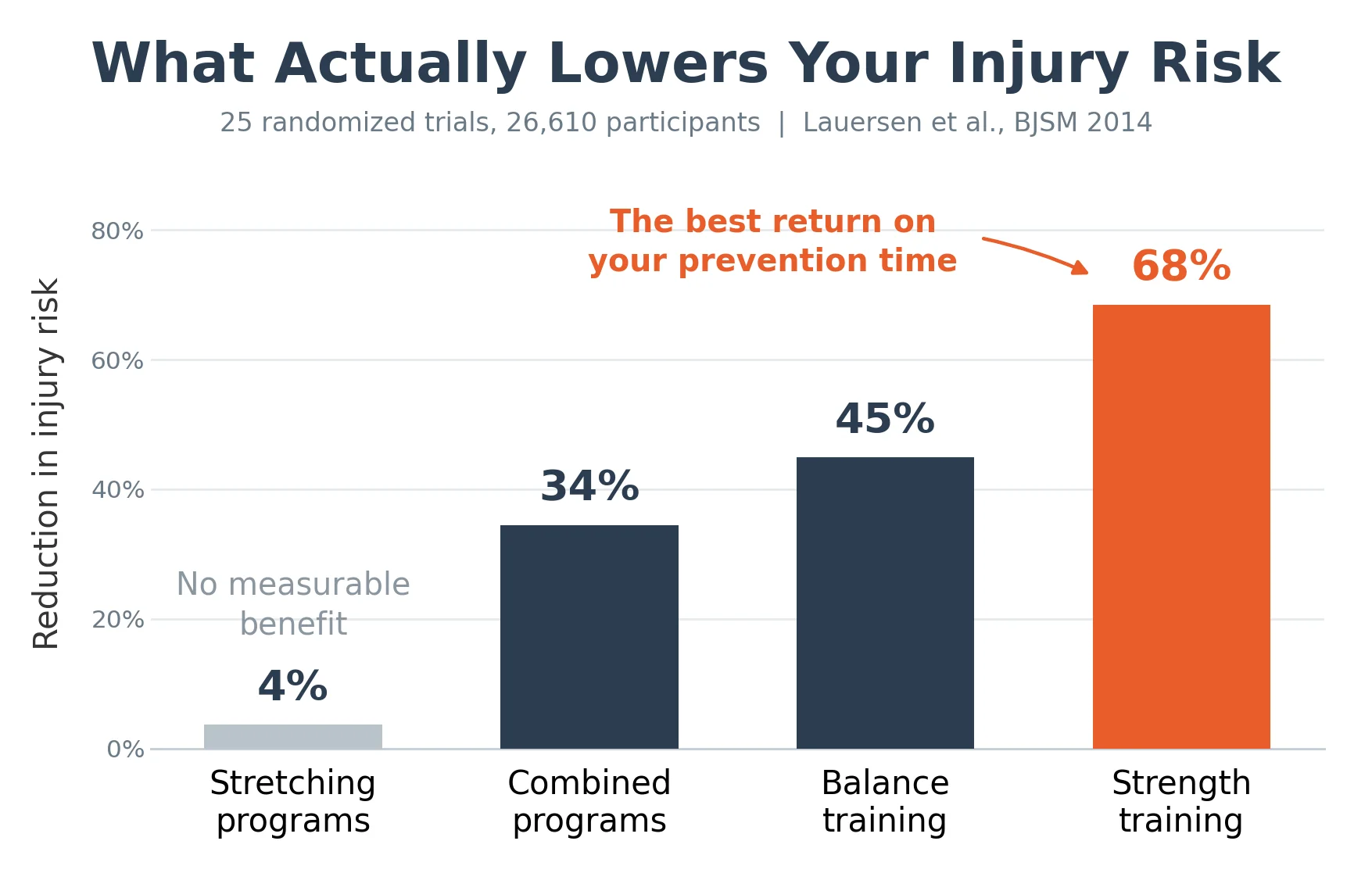
A meta-analysis of 25 randomized trials protecting 26,610 individuals and three,464 accidents discovered that stretching applications produced no measurable discount in damage charges.
Energy coaching in the identical evaluation reduce accidents to beneath a 3rd, and stability work roughly halved them.
Stretching nonetheless has a spot.
It improves vary of movement, it feels good on a stiff hip flexor, and no proof suggests it causes hurt.
It earns not one of the ten minutes you might be spending on damage prevention.
The best way to Spend Your Ten Minutes Earlier than a Run
Exchange the static holds with a warm-up that raises tissue temperature and rehearses the motion you might be about to do.
Stroll or jog straightforward for 3 to 4 minutes. This raises muscle temperature, which is the precise mechanism behind a warm-up.
Do 5 to six minutes of dynamic work. Leg swings entrance to again and facet to facet, strolling lunges, A-skips, and excessive knees.
End with 4 strides of 20 seconds. Construct to roughly 5k effort and float again down.
Save the lengthy static holds for after the run or for a separate mobility session on a straightforward day.
6. Taking Ibuprofen Earlier than a Run or a Race
Pre-race ibuprofen is widespread sufficient to indicate up in most ultramarathon fields, and it carries a measurable value to your kidneys.
Operating already reduces blood movement to your kidneys, and dehydration reduces it additional.
Ibuprofen works by blocking prostaglandins, hormone-like compounds that maintain the blood vessels feeding your kidneys open beneath that type of stress.
One further case of kidney damage occurred for each 5.5 runners who took the drug.
The second downside is the one bodily therapists care about extra.
Ache is the sign that tells you your stride is about to vary.
Blunting it on race morning removes the one warning system you’ve got between mile 6 and mile 20.
The best way to Deal with Race-Day Aches With out Reaching for NSAIDs
Repair the enter within the weeks earlier than the race, then handle the morning with issues that don’t contact your kidneys.
Lengthen the warm-up. Give a cranky Achilles or a sore hip a full quarter-hour and two further strides.
Use caffeine. It lowers perceived effort and has a powerful efficiency report with no renal impact.
Discuss to your physician about non-NSAID choices when you genuinely want ache aid on race day.
Maintain off on anti-inflammatories for the primary 48 hours after the race as nicely, as a result of that window is when tendon and bone transforming indicators are strongest.
7. Underfueling By means of a Coaching Block — The Strongest Predictor of a Stress Fracture
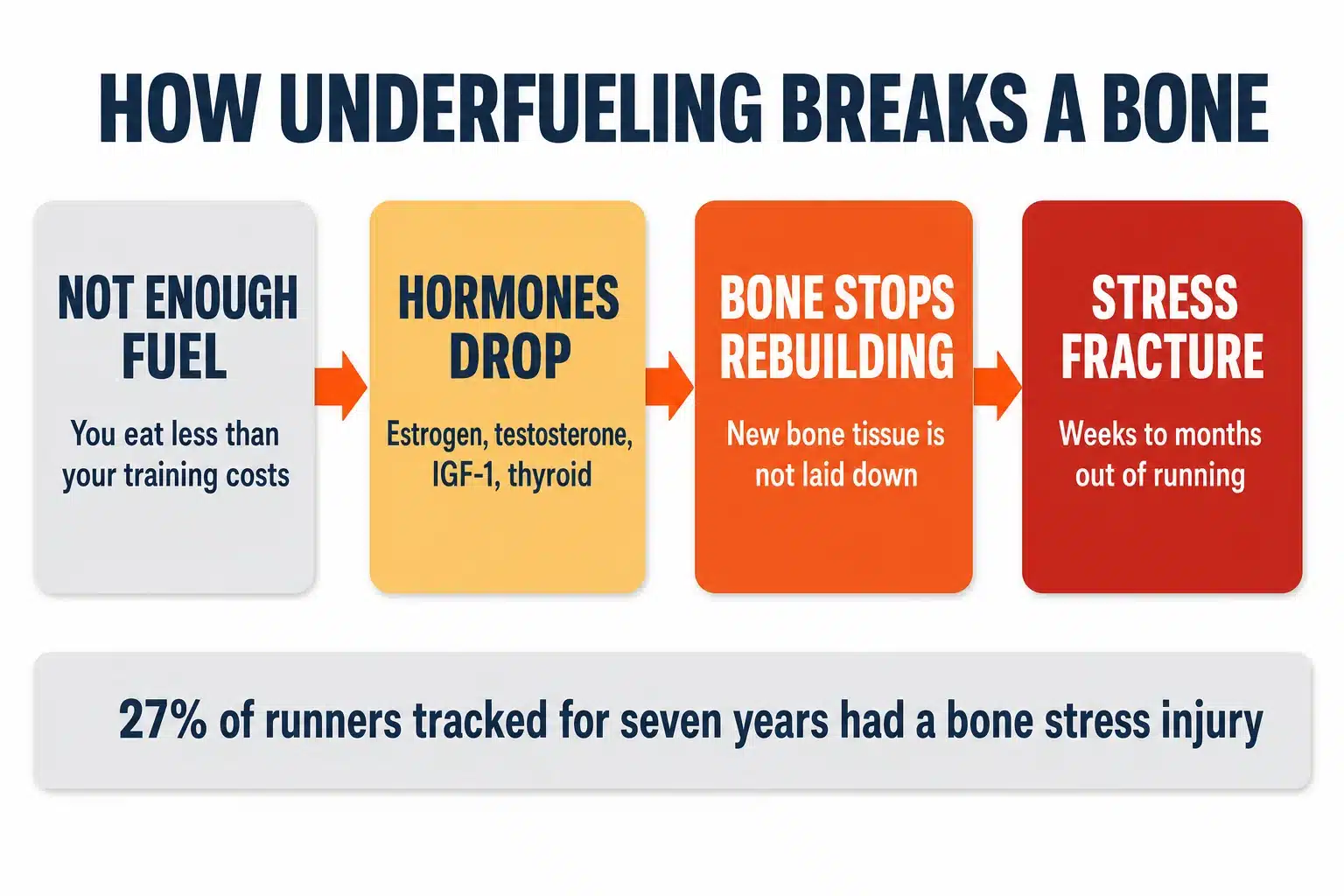
Persistent underfueling predicts bone stress accidents higher than any biomechanical measurement anybody has examined.
Runners with textbook mechanics get stress fractures, and runners with poor mechanics usually don’t.
What separates them most reliably is whether or not they ate sufficient to cowl their coaching.
Low power availability suppresses estrogen, testosterone, IGF-1, and thyroid hormones.
The IOC consensus assertion on Relative Power Deficiency in Sport identifies that hormonal suppression as a major driver of bone loss in endurance athletes.
Your bones cease laying down new tissue, and the calcium you’re taking doesn’t change that.
The sample repeats in girls, the place a five-year potential research of feminine runners discovered greater than 4 instances the speed of bone stress accidents within the highest-risk group.
The best way to Inform Whether or not You’re Fueling the Coaching You’re Doing
These indicators present up weeks earlier than a bone offers out.
Physique weight drifting down throughout a construct when you weren’t making an attempt to shed weight
Urge for food that disappears after onerous classes and returns as intense starvation at evening
Chilly fingers and toes and problem staying heat on straightforward runs
Damaged sleep and a resting coronary heart charge that won’t settle
Missed or irregular intervals, which is a symptom and a driver on the identical time
Eat carbohydrate earlier than each run over 60 minutes, refuel inside an hour of ending, and add an actual snack on any day over 8 miles (13 km).
A coaching construct is the improper time to be in a calorie deficit.
8. Operating Each Mile in Your Race Footwear
Carbon-plated race footwear earn their place on race day and trigger issues after they grow to be your solely pair.
The plate stiffens the forefoot and shifts work away out of your foot and ankle, which modifications the place load lands on each stride.
Sports activities drugs researchers documented 5 navicular bone stress accidents in aggressive runners utilizing carbon fiber plate footwear, and flagged a sluggish transition because the smart precaution.
Selection in what you place in your toes additionally has potential information behind it.
Monitoring 264 runners over 22 weeks confirmed roughly 39% decrease damage threat in those that rotated between a number of pairs of footwear.
Hold the plated footwear for races and one key session per week, and rotate two different pairs with completely different stack heights and drops by means of your straightforward mileage.
9. Operating Simple Days at Average Effort
Simple days that drift into average effort sit beneath a big share of the overuse accidents that attain a clinic.
Most runners maintain their straightforward tempo someplace between genuinely straightforward and comfortably onerous, as a result of that tempo feels productive and the watch quantity appears to be like respectable.
That zone is just too onerous to recuperate from and too straightforward to set off adaptation.
You arrive at your onerous classes already fatigued, so you can’t attain the intensities that drive health.
Your tissue by no means will get a genuinely low-load day to transform both.
The load that breaks a tendon is never the load from one session.
A scientific evaluation of 36 research protecting 23,047 runners discovered no constant hyperlink between damage and any single coaching parameter, together with weekly distance, frequency, or depth by itself.
Complete accrued stress throughout the week is what issues, and simple days that aren’t straightforward are the most important hidden contributor to that whole.
The best way to Make Your Simple Days Truly Simple
Use effort, not tempo, and be prepared to be slower than you count on.
Maintain a full dialog in full sentences. In case you are talking briefly bursts, you might be working too onerous.
Add 60 to 90 seconds per mile (about 40 to 55 seconds per km) to your marathon tempo. That vary is the place most on a regular basis runners’ straightforward tempo really sits.
Cap straightforward days by time, not distance. Fatigue modifications your mechanics late in a run, and a time cap stops you chasing a spherical quantity on drained legs.
Give this 4 weeks earlier than you decide it, as a result of the primary two weeks really feel like you might be losing your coaching.
Begin With the Two Habits That Price You the Most
9 habits is greater than anybody can change without delay, so decide the 2 with the most important impact on this checklist.
Add two heavy energy classes per week constructed round single-leg work for the hips and trunk.
Progress the load each week you possibly can end your units with two reps to spare.
Then sluggish your straightforward days down till you possibly can discuss in full sentences the entire manner.
In case you are damage proper now, apply the stride rule from merchandise one in your subsequent run earlier than you modify anything.