You possibly can add miles for months and nonetheless discover that your 5K tempo barely strikes.
That occurs as a result of mileage largely trains your coronary heart, lungs and the slow-twitch fibers in your legs. It does far much less for the way rapidly your mind recruits muscle and the way nicely your legs flip every foot strike into ahead pace.
That second piece is your neuromuscular health, and you’ll prepare it with a number of brief classes per week that add virtually no mileage.
Right here’s what you’ll find out about neuromuscular coaching:
What neuromuscular health is and why your simple miles don’t construct it
The 4 kinds of coaching that enhance it, with a starter dose for every
Methods to match them into your week with out operating extra
What Is Neuromuscular Health in Operating?
It’s how nicely your nervous system and muscle tissues work collectively to provide power rapidly on each stride.
A part of it’s what number of muscle fibers your mind can recruit directly and how briskly it fires them.
Your tendons matter too, as a result of a stiffer Achilles shops extra power at foot strike and returns extra of it while you push off.
You discover good neuromuscular health as higher operating financial system, which suggests you employ much less oxygen to carry the identical tempo.
Analysis has proven that changing a couple of third of endurance coaching with explosive energy work for 9 weeks made runners quicker over 5K and improved their operating financial system, with no change in VO2max.
Meaning the runners received quicker with out their cardio engine getting any larger.
The researchers traced the achieve to raised neuromuscular traits, which confirmed up as improved effectivity and the next prime pace on a maximal anaerobic treadmill check.
Why Doesn’t Extra Mileage Enhance Your Neuromuscular System?
Straightforward operating asks your legs to repeat the identical low-force stride hundreds of instances, so your nervous system has no purpose to recruit extra muscle or fireplace it quicker.
Your muscle tissues and nervous system adapt to the precise demand you place on them, a rule coaches name the S.A.I.D. precept, brief for particular variations to imposed calls for.
The identical 9-week examine confirmed what occurs while you stick with endurance coaching.
The athletes who stored doing their regular endurance coaching received slower over 20 meters and coated much less distance in a 5-jump check, despite the fact that their VO2max went up.
Endurance coaching alone can elevate your cardio health whereas your pace and energy fade.
You want that pace and energy while you change tempo, climb a hill or kick to the end.
RunnersConnect Bonus
Obtain your FREE Power Development slides.
Use these slides to simply create your individual progressive energy routine and adapt your energy work to the part of coaching you’re in.
Get My PDF Now
How Do You Enhance Your Neuromuscular System?
Brief, high-force work that your simple miles by no means present is what trains it.
4 kinds of coaching do that, and none of them add significant mileage.
1. How Do Strides Enhance Neuromuscular Health?
Strides are 20-second runs at roughly your mile race tempo, carried out on the finish of a simple run.
At that tempo your legs flip over quicker and push tougher in opposition to the bottom than they do at simple tempo, and 20 seconds is brief sufficient that your type holds collectively.
Begin with 4 strides after 2 simple runs per week, strolling or jogging for 60 seconds between each.
Over 4 to six weeks, construct to six to eight strides per session.
Maintain your steps fast and light-weight and your shoulders relaxed.
It is best to end every stride feeling like you may have gone quicker.
2. Are Hill Sprints Safer Than Flat Sprints?
Hill sprints are 8- to 10-second all-out efforts up a steep hill, they usually push your nervous system to provide maximal power at a decrease prime pace than flat sprinting, which is why coaches deal with them as a lower-risk technique to dash.
A 2013 examine put 20 well-trained runners by way of 6 weeks of uphill interval coaching at a variety of intensities.
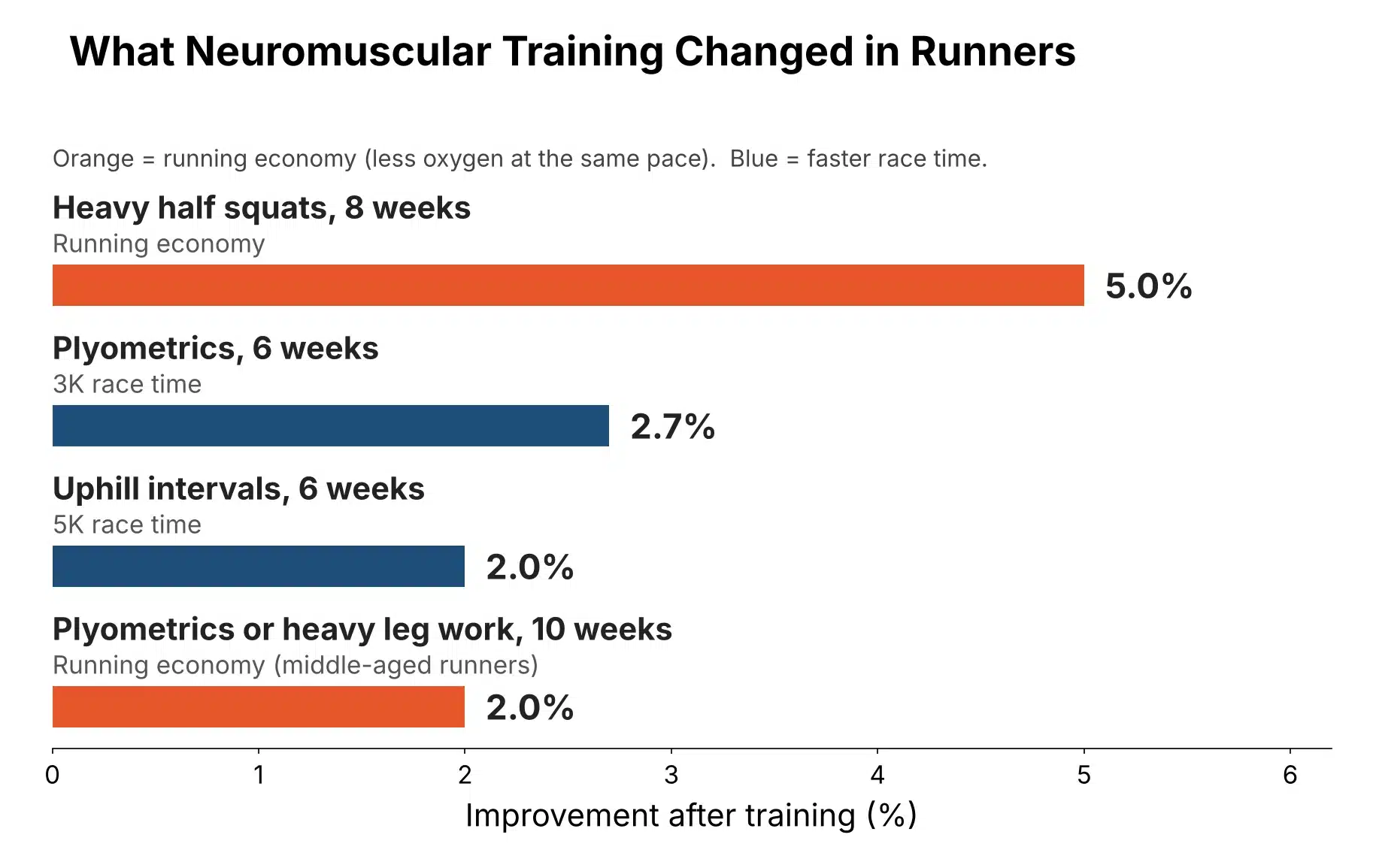
Their 5K instances improved by a mean of two.0%, and the toughest hill program produced the largest features in operating financial system and in each neuromuscular measure the researchers examined.
Meaning the toughest hill efforts are those that do probably the most on your neuromuscular system.
The slope additionally takes stress off your hamstrings.
Most analysis factors to the late swing part because the seemingly second hamstring strains occur throughout quick operating, when the hamstring is stretched arduous because it slows your decrease leg earlier than your foot strikes the bottom, based on a 2019 assessment.
On a hill, you’ll be able to’t attain your flat-ground prime pace, so your leg swings by way of extra slowly when you nonetheless push with near-maximal power.
Begin with 2 sprints of 8 seconds on a hill of about 6 to 10%, strolling again down for two to three minutes of full restoration between each.
Add 1 or 2 sprints per week till you attain 8 to 10, then lengthen every dash to 12 to fifteen seconds.
Do them as soon as per week, after a simple run or a exercise warm-up. Our information to explosive hill sprints covers the way to match them round your exercises.
3. Does Heavy Power Coaching Assist Distance Runners?
Heavy energy coaching is without doubt one of the best-researched methods to construct neuromuscular energy in distance runners.
A examine of well-trained runners discovered that 8 weeks of heavy half squats, 3 instances per week, improved operating financial system by 5% and allow them to run 21% longer at their maximal cardio pace.
The runners did 4 units of 4 reps on the heaviest weight they may carry 4 instances, and their physique weight didn’t change.
Their charge of power growth, a measure of how rapidly they may produce power, rose by 26%.
Meaning heavy, low-rep lifting trains your legs to provide power quicker, and in the identical runners every stride took 5% much less oxygen on the similar tempo.
Power work additionally lowers your harm threat.
A 2014 evaluation of injury-prevention trials throughout many sports activities discovered that energy coaching minimize accidents to lower than a 3rd.
Begin with 2 classes per week of two or 3 lower-body lifts, corresponding to squats, deadlifts and calf raises, utilizing a weight you’ll be able to carry 10 to 12 instances.
As soon as your type is strong, normally after 4 to six weeks, transfer to heavier units of 4 to six reps.
If you need a structured plan as a substitute of constructing routines your self, our Power Coaching for Runners program has 24 routines with prescriptions by race distance.
4. Do Plyometrics Make You a Extra Environment friendly Runner?
Plyometrics are leaping workouts that prepare your muscle tissues and tendons to soak up the power of every touchdown and launch it as quick as potential.
That stretch-and-recoil motion is what your calves and Achilles do on each stride.
In a 2003 examine, runners who added 6 weeks of plyometrics to their regular coaching ran a 3K 2.7% quicker.
Their decrease legs additionally turned stiffer, and the researchers consider that stiffer spring is what improved their operating financial system.
On a regular basis runners see the financial system achieve too, although it could not present up in race instances straight away.
A 2024 trial in middle-aged non-elite runners discovered that 10 weeks of both plyometrics or heavy leg workouts improved operating financial system by 2.0%.
Neither group ran a quicker 5K over these 10 weeks, so give this work a full coaching cycle earlier than you choose it.
Begin with 2 units of 10 pogo hops and a pair of units of 5 bounds as soon as per week on grass or a observe, earlier than your lifting whereas your legs are recent.
After 4 weeks, add field jumps or low drop jumps.
How Ought to You Match Neuromuscular Coaching Into Your Week?
Combining 2 or extra kinds of energy work beats counting on one.
A 2024 assessment of energy coaching research in middle- and long-distance runners discovered that combining two or extra energy strategies, corresponding to heavy lifting, lighter lifting or plyometrics, had a big impact on race instances.
Heavy lifting by itself had a average impact, and plyometrics on their very own had no clear impact.
Pair heavy lifting with plyometrics or lighter lifting for the largest features in race efficiency.
Your warm-up is the best place to start out.
Earlier than a exercise or race, add 2 or 3 strides and some drills like A-skips and excessive knees so your legs are used to quick, forceful motion earlier than the arduous operating begins.
Put your lifting, hill sprints and plyometrics in your exercise day or the day after, so your different simple days keep simple.
Every week for a runner coaching 5 days can appear like this:
Day
Operating
Neuromuscular work
Monday
Straightforward run
4 to six strides
Tuesday
Exercise
Drills and strides within the warm-up, heavy lifting after
Wednesday
Straightforward run
Hill sprints, then plyometrics
Thursday
Relaxation or cross-training
None
Friday
Relaxation
None
Saturday
Long term
None
Sunday
Straightforward run
4 to six strides
Right here’s a recap of every methodology:
Methodology
Starter dose
What it does
Strides
4 x 20 seconds after 2 simple runs per week
Teaching staple for quick, relaxed turnover that provides virtually no mileage
Hill sprints
2 x 8 seconds, as soon as per week
6 weeks of uphill intervals improved 5K time by 2.0%
Heavy energy coaching
2 classes per week, constructing to 4 to six reps
8 weeks improved operating financial system by 5%
Plyometrics
2 x 10 pogo hops and a pair of x 5 bounds as soon as per week
6 weeks improved 3K time by 2.7%