
You’ve spent the previous couple of years in low-drop trainers, possibly even zero-drop minimalist footwear that introduced you nearer to barefoot working. Now you’re desirous about making a swap.
Possibly your coach advised you that higher-drop footwear would assist with an Achilles situation, or possibly you’re simply bored with managing the fixed calf tightness that comes with minimal cushioning.
Both means, you’re standing in a working retailer footwear with an 8 to 12 mm heel drop, questioning whether or not the swap will really feel too totally different.
The swap itself is straightforward. What causes harm is doing it too quick, earlier than your physique has tailored to the brand new heel angle.
Your physique has tailored to working in low-drop footwear over months or years. Your Achilles tendon has realized to deal with fixed loading.
Your calf muscle tissue have shortened to match the low-drop angle. Your foot strike sample has doubtless shifted ahead.
If you leap straight into high-drop footwear, you drive all of these variations to reverse without delay, and that reversal is the place the accidents come from.
So, on this article you’re going to study the research-backed sensible recommendation on:
How shoe drop impacts your working biomechanics
Why your calves and Achilles get sore while you transition
The precise timeline for a secure transition
Every week-by-week protocol you possibly can comply with
Which runners are at highest threat through the swap
What’s shoe drop and why does the quantity matter on your working?
Shoe drop is the peak distinction between the heel and the forefoot of your shoe, measured in millimeters.
A zero-drop shoe has the identical quantity of cushioning below the heel as below the forefoot. A ten mm drop shoe has 10 mm extra cushioning below the heel than below the forefoot.
The quantity issues as a result of it modifications the angle of your foot at preliminary contact with the bottom.
When your foot is elevated on the heel, your ankle dorsiflexes (bends upward) much less at contact, your forefoot strikes at a shallower angle, and you’re primed to land in your rear foot. When your foot sits flat or low, your ankle dorsiflexes extra, your forefoot makes contact first or on the similar time, and you’re positioned to land in your midfoot or forefoot.
This angle distinction cascades by means of your complete decrease physique, affecting how a lot drive your knee absorbs, how arduous your hip has to work, and the way a lot stress masses onto your Achilles and calf.
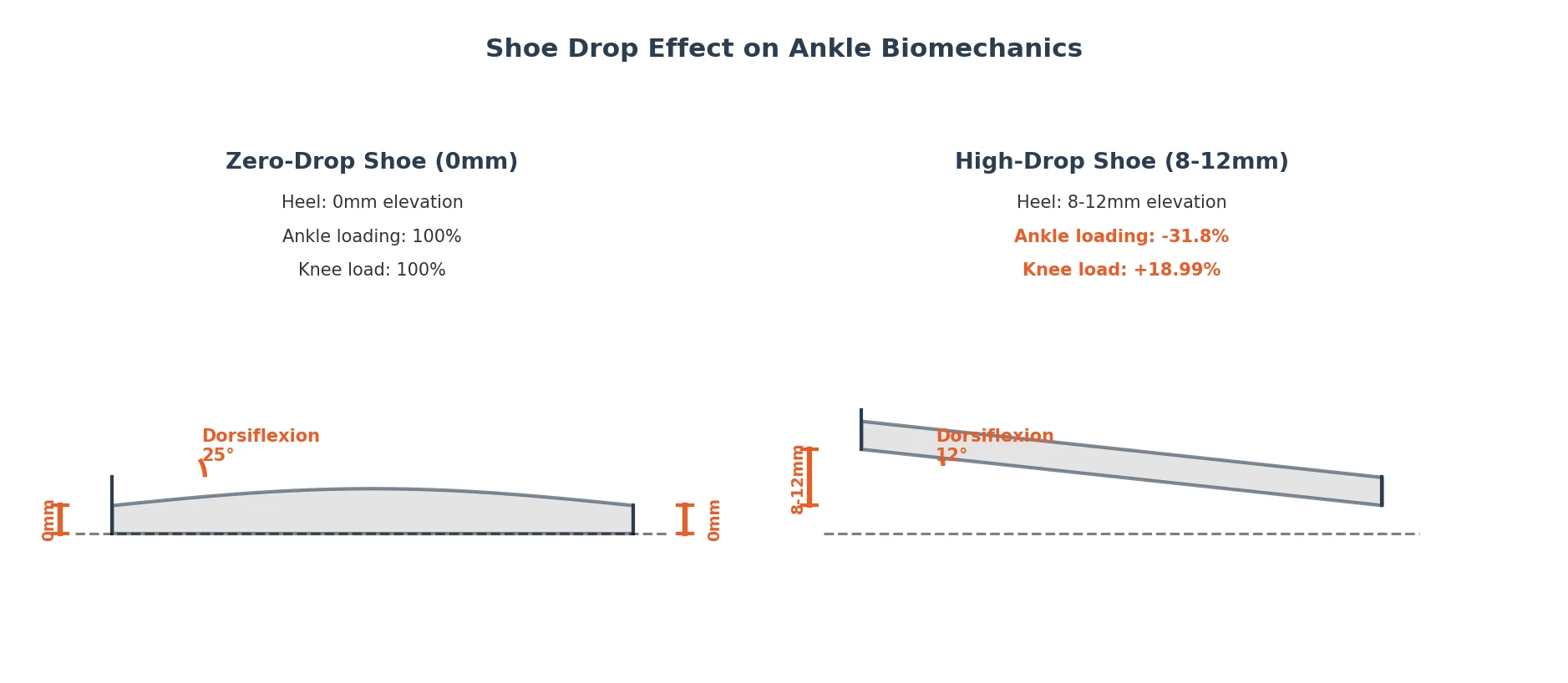
Analysis has proven that growing shoe drop from 0 mm to eight mm decreases loading charges on the ankle by 31.8% however will increase knee extension moments by 18.99%.
Meaning high-drop footwear take stress off your ankle and forefoot, then transfer a few of that load as much as your knee.
Shoe drop determines which elements of your physique deal with essentially the most influence on every stride, not whether or not your working is any good.
What occurs to your physique while you transition to higher-drop footwear?
If you begin carrying higher-drop footwear, your motion sample modifications instantly, even on the primary run.
Your ankle not has to dorsiflex as a lot as a result of the heel is already elevated. That smaller ankle movement strikes your strike level backward in your foot, shifting you towards a rearfoot strike.
Your stride size will increase since you land with an extended lever arm on the ankle.
Your knee angle at preliminary contact will increase, which modifications how a lot your knee flexes by means of the touchdown.
Your hip extensors (glutes and hamstrings) work tougher as a result of your torso sits in a different way while you land extra in your heel than in your midfoot.
An important change is in the back of your leg: your Achilles tendon and calf go from closely loaded on each run to instantly unloaded.
Your Achilles tendon has spent months or years below fixed tensile stress in low-drop footwear.
If you cut back that load rapidly, the tendon isn’t ready for the change in drive distribution. On the similar time, the shorter dorsiflexion vary means your calf now works in a shortened place.
That shortened place is what creates the tightness and the delayed soreness.
Soreness reveals up days after your first high-drop run as a result of your calf and Achilles adapt slowly to the brand new ankle angle.
Why do your calves and Achilles tendon get sore through the transition?
The soreness you are feeling in your calves and Achilles through the transition means you’re asking these tissues to work able they haven’t tailored to but.
A 12-week examine of runners transitioning from rearfoot-strike working in commonplace cushioned footwear to minimalist footwear discovered that Achilles tendon loading elevated throughout all teams.
Runners who made the transition with a forefoot strike sample confirmed a 20.3% enhance in peak Achilles drive.
The loading price elevated by 37.2%.
Analysis discovered that the Achilles tendon reaches peak stress inside 12 weeks of transitioning shoe sorts, and the mechanical loading of the tendon adapts throughout this era.
The reverse holds while you go from low-drop to high-drop footwear. You aren’t including Achilles load, however you’re altering how that load spreads alongside the tendon, and you’re shortening the place your calf works in through the stride.
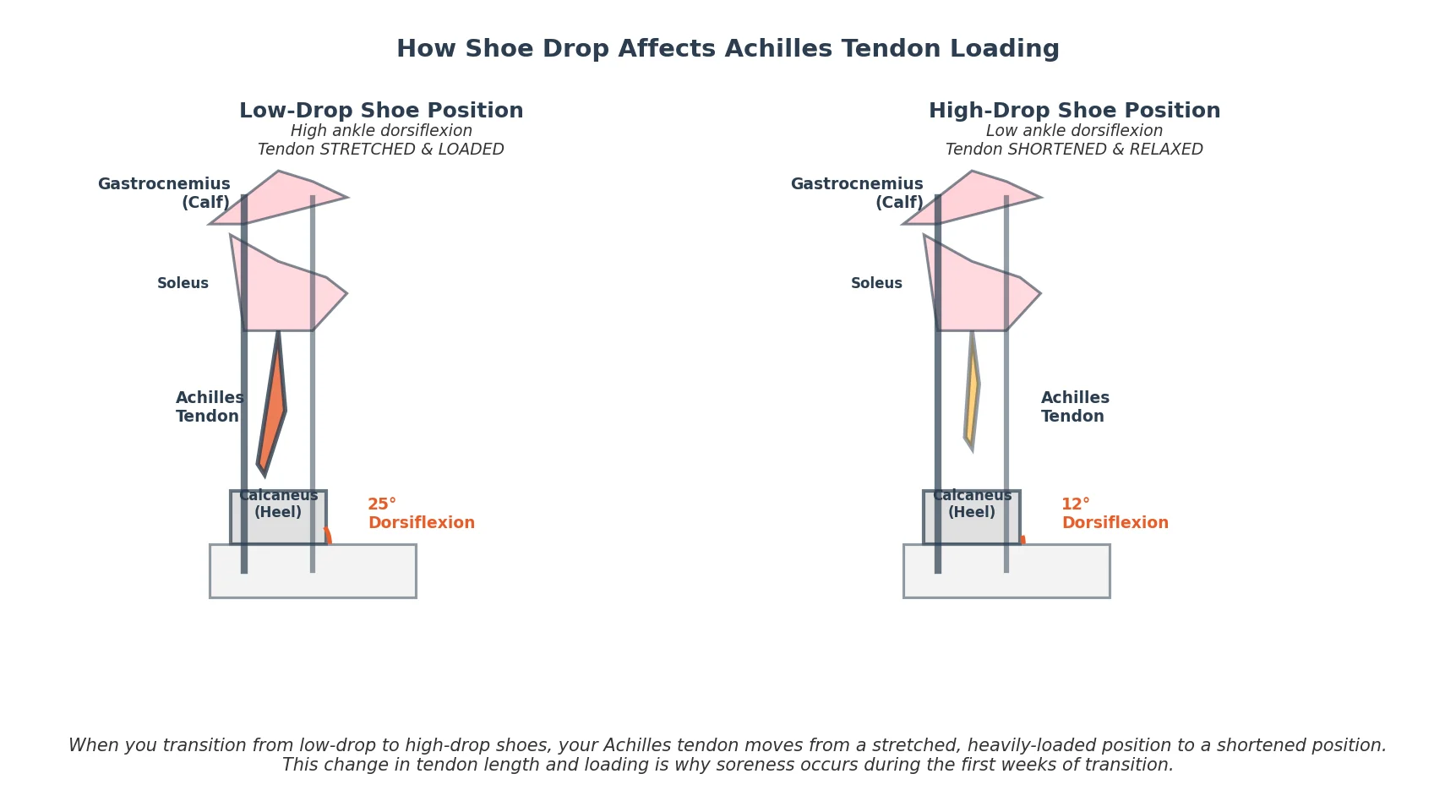
Your calf muscle fibers are tuned for the place they’ve held for months. When your ankle angle modifications, these fibers undergo a interval of micro-damage and rebuilding, and that rebuilding is what you are feeling as soreness.
Gradual development and focused strengthening forestall most of that soreness. Bounce into high-drop footwear too rapidly and it’s near assured.
RunnersConnect Bonus
Fighting Achilles Tendonitis or Retrocalcaneal bursitis? Obtain our Achilles Damage Prevention Routine.
It’s a PDF with photos and descriptions of the ten simplest prevention and rehab workouts for runners with Achilles points.
GET THE FREE GUIDE
How lengthy does it really take to transition safely?
If you would like a single quantity: 8 to 12 weeks for a secure transition, with 10 weeks being the lifelike goal for many runners.
The timeline will depend on a couple of components.
In case you’re at the moment working 20 miles per week with no important harm historical past, 8 weeks is affordable. In case you’re working 50+ miles per week, you want the complete 12 weeks as a result of your physique is dealing with extra complete influence load.
When you’ve got a historical past of calf pressure, Achilles tendonitis, or plantar fasciitis, your physique wants extra time to adapt as a result of these tissues are already sensitized.
Your age issues too. Runners over 40 are likely to take barely longer to adapt to new footwear patterns, although particular person variation is big.
That quantity comes from runners who skip the intermediate steps. They go from cushioned footwear with a ten mm drop straight to zero-drop or 2 mm footwear, in a single day, with no gradual development.
The 14% who keep away from harm are those who progress slowly. A secure transition takes 8 to 12 weeks, and that timeline is non-negotiable if you wish to keep away from harm.
What’s the week-by-week protocol for transitioning safely?
The protocol has a easy basis: begin low, go gradual, and blend your footwear for the primary a number of weeks.
“Begin low” means your first week in higher-drop footwear needs to be 5% of your weekly working quantity.
In case you run 30 miles per week, that’s 1.5 miles within the new footwear throughout week 1.
The opposite 95% of your miles keep in your low-drop footwear.
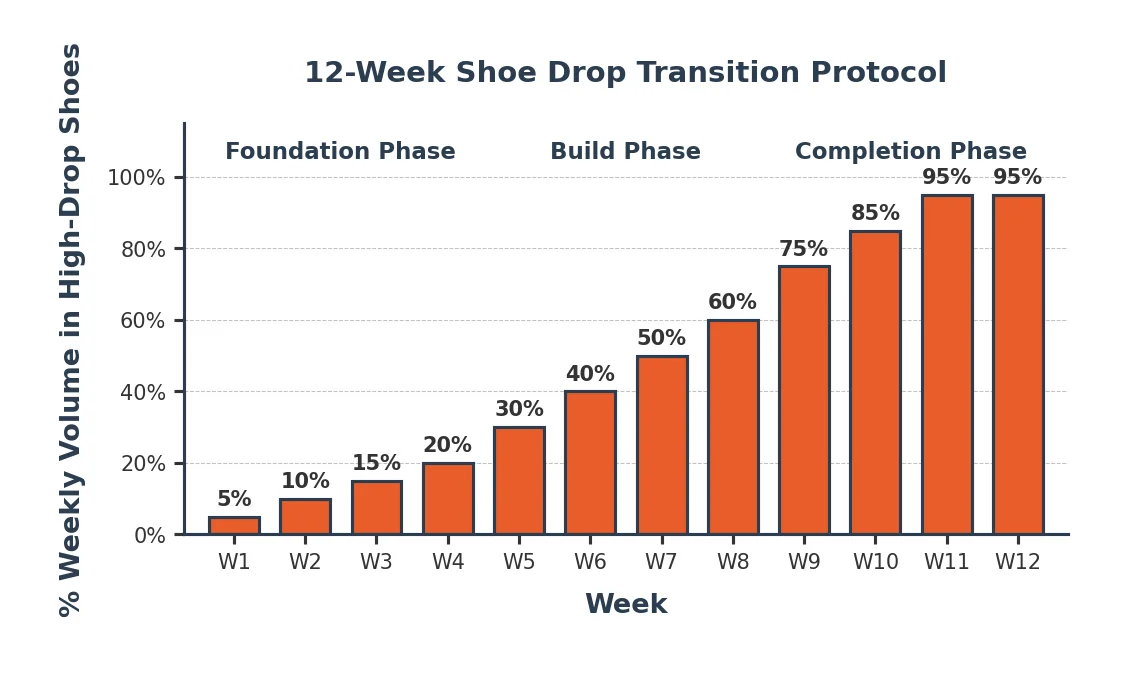
Weeks 1–4: The Basis Section
Week 1: Run 5% of your weekly quantity in high-drop footwear. Most of this can be simple runs.
Week 2: Improve to 10% of your weekly quantity in high-drop footwear. You’ll be able to put on them for straightforward runs or one quick tempo phase, however maintain the stress low.
Week 3: Progress to fifteen% of your weekly quantity in high-drop footwear. You’ll be able to run one full simple run within the new footwear this week.
Week 4: Attain 20% within the new footwear. You’re nonetheless carrying your low-drop footwear for 80% of your working.
Weeks 5–8: The Construct Section
Week 5: 30% of your quantity in high-drop footwear. Begin including some tempo work or fartlek within the new footwear.
Week 6: 40% in high-drop footwear. You are able to do a brief pace exercise in them, however save your longest run on your low-drop footwear.
Week 7: 50% in high-drop footwear. You’re now splitting your miles evenly between each shoe sorts.
Week 8: 60% in high-drop footwear. Solely your longest run or one tempo run stays within the low-drop footwear.
Weeks 9–12: The Completion Section
Week 9: 75% in high-drop footwear. Maintain one simple run in your low-drop footwear for selection.
Week 10: 85% in high-drop footwear. Combine within the low-drop footwear solely often.
Week 11–12: 95% in high-drop footwear. You’ll be able to maintain one simple run per week in your low-drop footwear for selection, however you’re now primarily in high-drop footwear.
The important thing phrase in that protocol is “combine.” Analysis has proven that runners who rotate a number of totally different shoe fashions cut back harm threat as a result of various the stress patterns prevents overuse of any single construction.
That very same analysis discovered that runners utilizing a stepwise development with each shoe sorts without delay reached a 70.8% success price, effectively above the harm charges seen in runners who switched abruptly.
Don’t image these 12 weeks as “carrying new footwear” then “carrying previous footwear.” Image them as carrying each footwear in a ratio that shifts a bit of every week.
Throughout all the 12-week interval, you must also do calf and Achilles strengthening twice per week. Single-leg calf raises, eccentric heel drops, and isometric calf holds put together your Achilles for the brand new calls for and head off the post-run soreness that derails most transitions.
Calf strengthening workouts are important throughout this part, not optionally available extras.
The week-by-week development works provided that you persist with it, so leaping forward two weeks since you really feel good will undo the difference.
Which runners are most in danger through the transition?
Damage threat through the transition isn’t the identical for everybody. Some runners comply with this protocol with zero soreness.
Others comply with it completely and nonetheless find yourself with a calf pressure.
The runners at highest threat share these traits:
A historical past of calf pressure or Achilles tendonitis. Your tissues are already sensitized, in order that they react quicker to any change in load or angle.
A big leap in drop. Going from a really low drop (0–2 mm) to a really excessive drop (10–12 mm) creates an even bigger biomechanical shift, which implies extra adaptation work on your physique.
Excessive present mileage (50+ miles per week). Your complete influence load is already excessive, so including the stress of adaptation on prime of it raises the chance.
Over 40 and returning to working after day without work. Older tissues and not too long ago deconditioned tissues each take longer to adapt to new motion patterns.
Greater than two weeks off working previously six months. In case you’re managing a latest minor harm or got here again from a break, your tissues are already under their regular adaptation capability.
In case you match any of those profiles, prolong your transition from 12 weeks to 14–16 weeks and prioritize calf strengthening above every little thing else.
Do it’s good to change your working type while you swap shoe drops?
Your working type modifications while you swap shoe drops, however deliberately altering your method is just not required and infrequently creates extra issues than it solves.
If you run in higher-drop footwear, your foot strike shifts rearward by itself. You land extra in your heel as a result of the heel elevation makes that the trail of least resistance.
You don’t have to drive a heel strike. It occurs robotically.
Your cadence drops barely and your stride size will increase barely, each with none aware effort.
Runners get into bother after they attempt to maintain their low-drop type (excessive cadence, quick foot turnover, excessive knee drive) whereas working in high-drop footwear. That works towards the shoe’s biomechanics and creates harm threat as a substitute of stopping it.
Greater-drop footwear transfer your strike level rearward with no teaching cues wanted. The joint-loading modifications documented within the analysis drive that adaptation for you.
The one intentional change value making is refined: land with a slight knee bend as a substitute of a straight or locked knee. That reduces influence forces and offers your muscle tissue and tendons time to soak up the shock.
All the things else (strike sample, cadence, stride size) adapts by itself in case you comply with the development protocol.
The minimalist to maximalist shoe transition protocol follows the identical rule: let your physique discover its pure adaptation pathway as a substitute of making an attempt to override it.
Let your physique adapt to the shoe as a substitute of forcing type modifications, as a result of your biomechanics regulate extra precisely than your aware cues do.