You hit mile 10 of your marathon, and the power gel you took at mile 5 sits like a brick in your abdomen.
Nausea builds and your tempo drops.
You dig by your hydration pack and discover the applesauce pouch you grabbed as backup.
One squeeze later, the cramps ease and your legs really feel lighter.
You run the final 16 miles stronger on complete meals than you probably did on engineered gas.
This occurs to extra runners than sports activities diet firms wish to acknowledge. Business gels work brilliantly for some athletes and wreak digestive havoc on others.
Your abdomen may tolerate pure carbohydrates higher than the thickened, stabilized components that engineered gels use.
So, on this article you’re going to study the research-backed sensible recommendation on pure alternate options to power gels that really work on race day.
Which complete meals ship carbs as reliably as gels and which of them don’t
Why your abdomen tolerates apples and bananas higher than industrial gels
Methods to gas a marathon solely on pure carbs with out sacrificing efficiency
When gels nonetheless make sense (and when it is best to skip them fully)
Why Runners Tolerate Pure Carbs Higher Than Gels
Business power gels are engineered to pack most energy into minimal quantity, which creates an issue on your abdomen.
A typical gel packs 20 to 25 grams of carbohydrate into about 1 oz (30 ml), which makes it a much more concentrated dose of sugar than a sports activities drink or a bit of fruit.
That’s why gel labels inform you to take each with water.
Taken with out sufficient water, that concentrated sugar sits in your abdomen longer, which might set off nausea and cramping.
This occurs particularly once you’re working, as a result of blood diverts away from digestion and towards your legs.
Complete meals unfold their carbohydrate by extra water and bulk.
Applesauce has a texture much like gel however is generally water, so it goes down simply mid-run.
A 2012 examine of 11 runners discovered that consuming raisins or industrial sport chews throughout 80 minutes of working produced the identical 5 km time trial afterward, 20.6 vs 20.7 minutes, with solely delicate abdomen signs on both.
The carbohydrate tolerance image turns into extra nuanced once you take a look at the forms of sugar concerned.
Most industrial gels use glucose and fructose blends particularly as a result of these sugars are absorbed by completely different intestinal transporters (SGLT1 for glucose, GLUT5 for fructose).
Complete meals comprise a number of carbohydrate varieties naturally.
Bananas ship glucose, fructose, and sucrose in a single fruit.
Honey incorporates roughly equal elements glucose and fructose.
Dates comprise a mixture of glucose and fructose.
Meaning whole-food carbohydrate can gas a run about in addition to industrial gas, so the higher selection is whichever one your abdomen handles.
For those who constantly expertise abdomen misery on gels however tolerate strong carbs throughout coaching runs, the problem is probably going the gel formulation itself, not carbohydrate supplementation as a class.
For runners susceptible to GI misery throughout racing, a focused probiotic formulated for endurance athletes can scale back symptom severity additional.
MAS Flush incorporates Bifidobacterium strains proven in analysis to cut back GI signs by 50–57 p.c in marathon runners, making it a sensible complement to a pure fueling technique.
It additionally ranked first in our comparability of the 6 greatest probiotics for runners.
Which Complete Meals Match Gel Carbohydrate Supply
Gel and complete meals aren’t interchangeable, however many pure meals match gel energy so carefully that the distinction disappears in sensible working.
Customary power gels ship 20–25 grams of carbohydrate per serving, which takes up about 1–1.5 ounces of quantity.
Right here’s how widespread pure carbs stack up in opposition to that benchmark:
Meals
Portion Dimension
Carbs (grams)
Sensible Notes for Operating
Applesauce (single pouch)
3.2 oz (90 g)
10–20g
Sweetened pouches sit close to 18–20g and unsweetened close to 10–12g, so verify the label; no chewing required; simple on the abdomen
Honey (liquid or packet)
1 tablespoon
17g
Pure glucose/fructose mix; absorbs rapidly; requires water to devour; viscosity much like gel
Banana (medium, 7–8 inches)
1 complete fruit
27g
Incorporates glucose, fructose, and sucrose; slower digestion as a consequence of fiber and resistant starch; requires chewing; most transportable; value: $0.20–$0.50
Raisins (small handful)
1/4 cup (40g)
About 30g
Concentrated carbs; requires in depth chewing; choking threat on run; higher as pre-run gas; value: $0.30–$0.60
Dates (giant Medjool, pitted)
1 date (24g)
18g
Glucose/fructose combine; chewy texture (simpler than raisins); transportable; value: $0.30–$0.50
Dried apricots (medium halves)
5–6 items
20g
Just like dates; chewy; much less generally utilized by runners however viable various
Applesauce is the closest gel equal in texture and comfort: a squeeze pouch, no chewing, and a decrease value, although most pouches carry fewer grams than a gel.
Single-serve applesauce pouches (sometimes bought in child meals sections) ship 10–20 grams of carbs, relying on whether or not they’re sweetened, for $0.50–$1.00 per serving, in comparison with $1.50–$2.50 for industrial gels.
Honey works the best way a gel does: it’s a concentrated mixture of glucose and fructose that you simply squeeze in and chase with water.
Bananas are probably the most transportable pure possibility and require zero packaging, however their increased fiber content material slows digestion barely, making them higher suited to pre-run fueling (90–120 minutes earlier than begin) than mid-race supplementation.
Raisins and dates supply transportable carbohydrate density however require important chewing and current choking hazard throughout onerous working, in order that they work greatest as coaching gas or pre-race loading, not race-day fueling.
Applesauce pouches and honey packets are the whole-food choices that come closest to how a gel works throughout a run.
Sensible Fueling Timing: When to Use Pure Carbs vs Gels
The correct gas relies upon fully on what stage of your run or race you’re in.
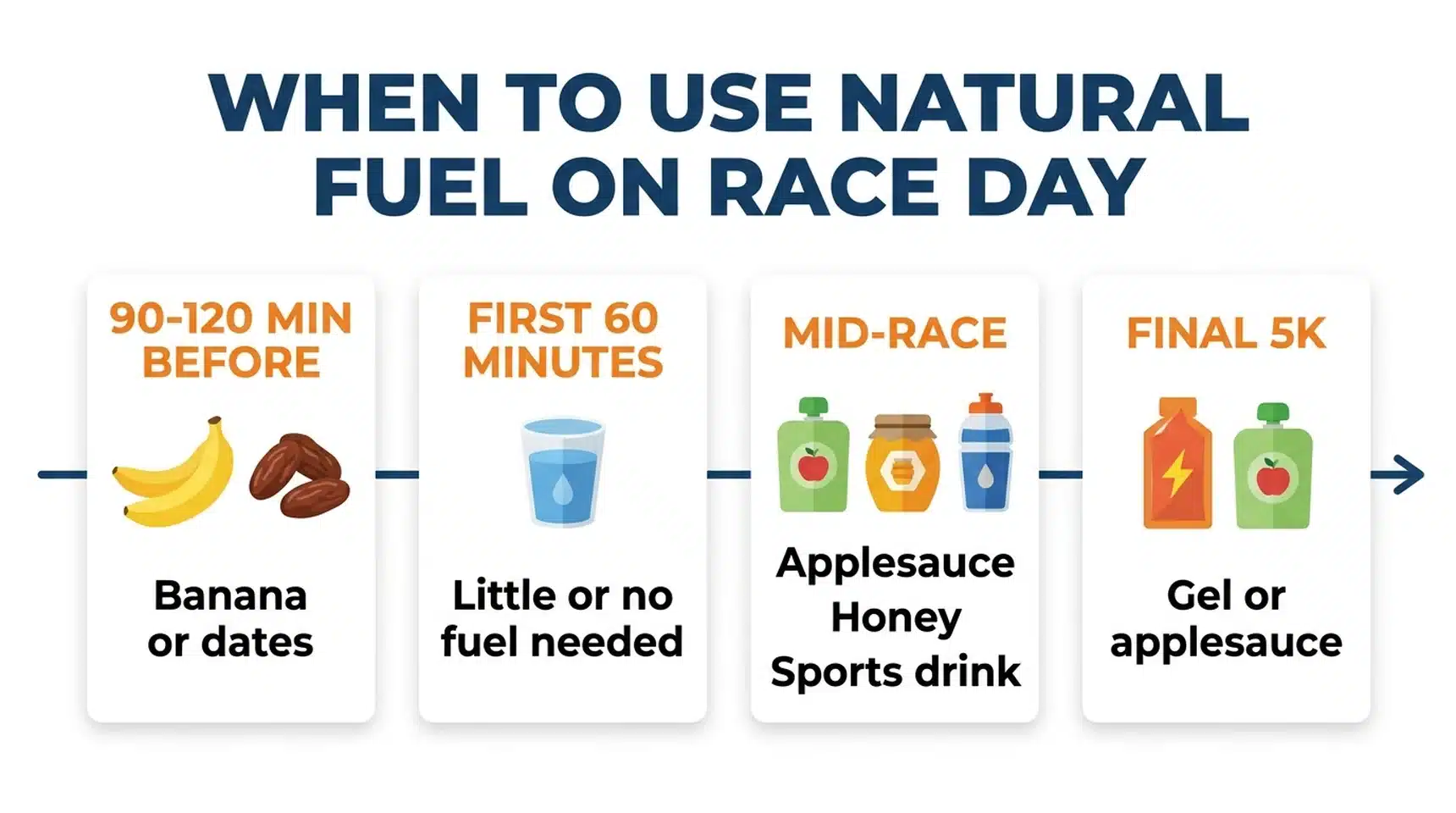
Pre-run fueling (60–120 minutes earlier than you begin):
Pure complete meals excel right here as a result of slower digestion aligns together with your power timeline.
A banana 90 minutes earlier than a race releases carbs steadily as you heat up, avoiding the sugar spike-and-crash that may happen with gel taken too early.
Early race fueling (first 60 minutes):
Most runners don’t want gas in the course of the first hour if the pre-race meal was sufficient.
For ultra-marathons or very lengthy efforts, pure carbs work tremendous throughout this window as a result of there’s no urgency but.
Mid-race fueling (75–180+ minutes, the essential window):
That is the place gel design turns into related since you’re working onerous, your abdomen is jostled by influence, and also you want carbs now.
Applesauce packets and honey packets nonetheless work and soak up rapidly at this stage.
Bananas require extra chewing, which distracts from pacing and may set off nausea throughout onerous working, whereas raisins and dates enhance choking threat once you’re respiration onerous.
For marathoners at leisure tempo (3:30+), pure carbs suffice all through. For quicker runners focusing on sub-3:00 occasions, alternating gels with applesauce or honey reduces abdomen load with out sacrificing the absorption pace you want late within the race.
Remaining 5k push: Gels regain benefit since you want carbs quickly and chewing could be disruptive. Applesauce nonetheless works, however another complete meals turns into impractical.
For many non-elite runners doing marathons, alternating gels with applesauce or honey reduces total GI misery with out sacrificing efficiency, since you don’t hit the carbohydrate absorption ceiling that makes pure-gel fueling essential for elite athletes.
A sensible race technique: gas each 25 to half-hour with 20–25 grams of carbs (both a gel or 1 to 2 applesauce pouches, alternating to cut back gel-induced nausea) plus water.
Check this actual technique in your longest apply run earlier than race day, as a result of particular person tolerance varies dramatically.
Whenever you apply your marathon diet in coaching, you discover out which gas technique your abdomen can deal with underneath race-day stress.
Prepared For Extra?
Then begin our FREE Race Day Fueling e mail course!
You’ll discover ways to calculate once you’ll bonk, how you can hydrate, what meals to eat throughout your race, and extra! From case research to scientific analysis, we’ll show you how to discover ways to greatest gas on your subsequent race.
Begin My Free Course Now
The Carbohydrate Absorption Downside Gels Declare to Resolve
Understanding why gels have been engineered within the first place clarifies once you really want them.
All carbohydrate absorption hits a ceiling.
For those who devour solely glucose (a single transportable carbohydrate), your small gut can soak up about 60 grams per hour, as a result of just one intestinal transporter (SGLT1) handles it.
A 2005 examine of skilled cyclists confirmed that by combining glucose with fructose (which makes use of a unique transporter, GLUT5), you’ll be able to push carbohydrate oxidation charges as much as 105 grams per hour, since you’re utilizing each pathways concurrently.
Over a 3-hour marathon, 105 grams per hour would add as much as greater than 300 grams of carbohydrate.
This represents an unlimited caloric benefit late within the race when glycogen shops deplete.
Complete meals typically comprise this dual-carbohydrate make-up naturally: bananas ship glucose, fructose, and sucrose, honey is roughly 50-50 glucose and fructose, and applesauce is a combination.
They partially bypass the single-transporter ceiling, however not as effectively as engineered gels that optimize glucose-to-fructose ratios particularly.
Nonetheless, this benefit solely issues for those who’re pushing onerous sufficient to wish 90+ grams of carbohydrate per hour.
Most leisure runners keep nicely beneath that threshold.
A 4-hour marathoner burns roughly 2,500 to three,000 energy whole, consuming perhaps 50–60 grams of carbs per hour from fueling, which is at or beneath the single-transporter ceiling.
For that runner, the absorption benefit of dual-carb engineering disappears. Pure carbs work equally nicely.
The multi-carbohydrate absorption benefit that makes gels superior primarily applies to elite marathoners working sub-3:00 occasions, as a result of leisure runners don’t hit the carbohydrate ceiling with pure fuels.
Can a Sports activities Drink Change Your Power Gels?
A carbohydrate drink can gas you in addition to a gel can, so long as you drink sufficient of it.
A 2010 examine of skilled cyclists discovered that the identical glucose and fructose combine was burned on the identical peak charge, about 1.4 grams per minute, whether or not it got here as a gel or as a drink, by the top of three hours of biking.
Meaning the shape your carbohydrate is available in issues far lower than what number of grams you get in every hour.
Quantity is the place a drink falls wanting a gel, as a result of the identical carbohydrate comes unfold by much more fluid.
Most sports activities drinks are 6 to eight% carbohydrate, so an 8 oz (240 ml) cup provides you about 14 to 19 grams.
To get 60 grams an hour from a 6% drink alone, you’d must drink about 34 oz (1 liter) each hour.
That’s plenty of fluid to soak up from support station cups at race tempo.
So a sports activities drink works greatest as one piece of your plan, masking your fluid and a part of your carbohydrate whereas applesauce or honey covers the remainder.
For those who gag on something thick, a drink can be the best option to get carbohydrate in with out touching a gel.
Examine the label earlier than race day, as a result of the sugar focus of your sports activities drink decides what number of grams every cup provides you.
How Do You Gasoline a Marathon With out Gels?
Fueling a marathon or a long term with out gels comes all the way down to hitting a carbohydrate goal every hour with meals you’ll be able to carry and swallow whereas working.
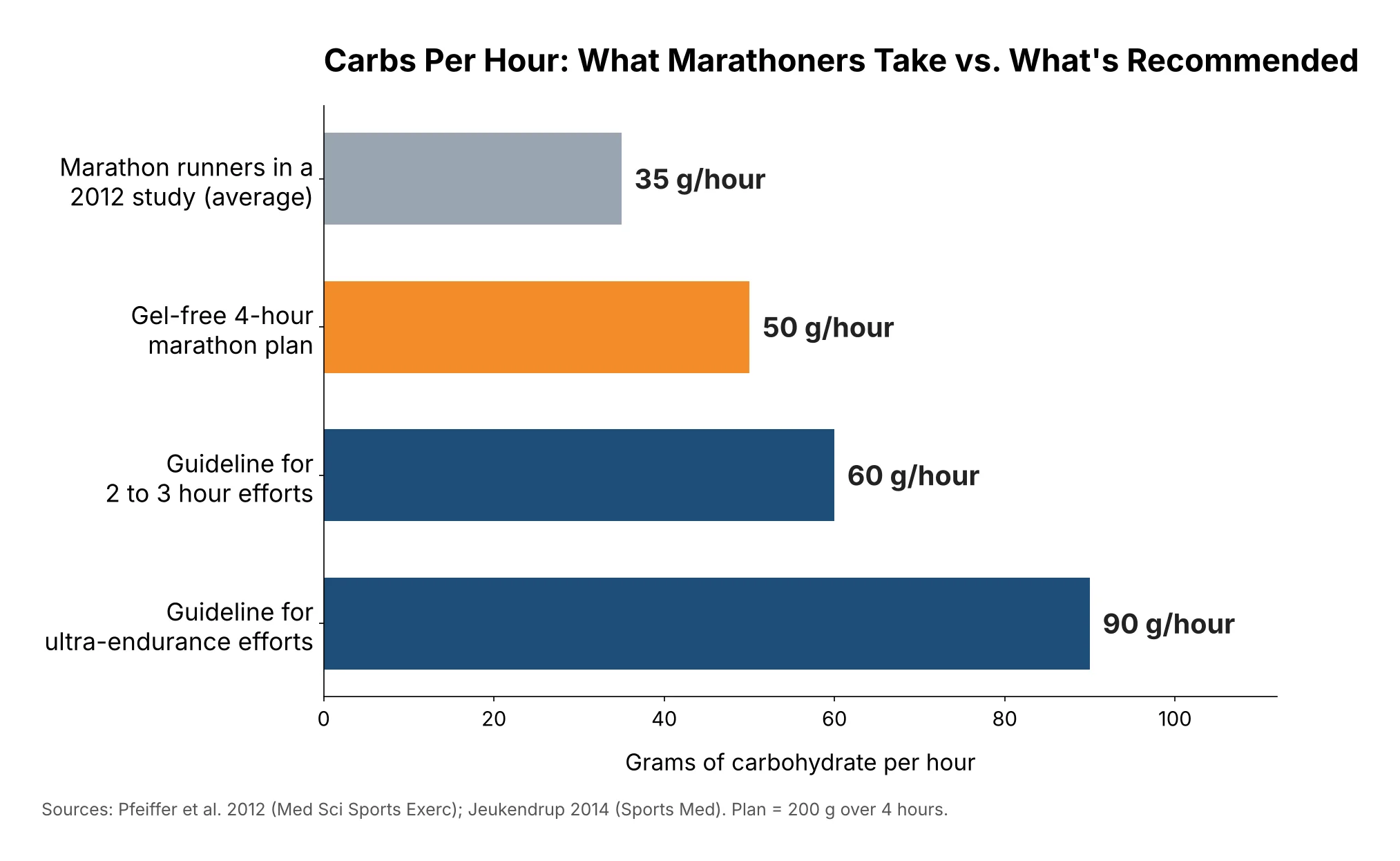
For efforts lasting 2 to three hours, present sports activities diet tips suggest about 60 grams of carbohydrate per hour.
That carbohydrate can come from a liquid, a semi-solid or a strong meals.
The goal can come down a bit of at a simple or reasonable effort.
In actual races, marathoners have a tendency to soak up far lower than 60 grams an hour.
Meaning the everyday marathoner in that examine raced on a bit of over half the carbohydrate the rules name for.
With pure meals that shortfall is tough to keep away from, as a result of most servings carry fewer grams of carbohydrate than a gel.
The best option to shut that hole is to begin with the whole and work backward.
A 4-hour marathoner working at a reasonable effort and aiming for 50 grams per hour wants about 200 grams of carbohydrate throughout the race.
Right here’s one option to construct these 200 grams with out a single gel:
Gasoline
Serving
Carbs per serving
Servings
Complete carbs
Sweetened applesauce pouch
3.2 oz (90 g)
About 18g
6
108g
Honey
1 tablespoon (21 g)
17g
3
51g
6% sports activities drink at support stations
8 oz (240 ml) cup
About 14g
3
42g
Complete
12
About 200g
Unfold the 9 applesauce and honey servings throughout the race, one roughly each 20 to 25 minutes from the 30-minute mark, and take water with each.
Choose up the three cups of sports activities drink at support stations alongside the best way, ideally between your applesauce and honey servings.
The trade-off is weight, as a result of complete meals carry their carbohydrate in additional water and bulk than a gel does.
The 6 pouches and three tablespoons of honey you carry weigh about 600 g (21 oz) and maintain about 160 grams of carbohydrate.
Customary gels with 25 grams of carbohydrate would carry the identical 160 grams in about 210 g (7.5 oz), so the pure model weighs almost 3 occasions as a lot.
You’ll want a vest or a belt with room for all of it, or a good friend on the course who can hand you the second half.
Rehearse this actual plan in your longest coaching runs, as a result of carrying and consuming this a lot actual meals is a ability you practice your intestine to deal with, similar to the miles.
DIY Alternate options: Methods to Make Pure Fueling Work at Scale
For those who’re dedicated to racing on pure carbs, execution issues as a lot as meals selection.
Applesauce technique:
Supply single-serve pouches from manufacturers like Mott’s, which promote 3.2-ounce pouches in bulk for $0.40–$0.60 every, about half gel value.
Check them on 3–4 coaching runs earlier than committing to race day, and devour with water the identical approach you’ll a gel.
Honey packets:
Single-serving honey packets from espresso outlets or grocery shops ($0.10–$0.20 every) carry about 11 to 12 grams of carbs, roughly half a gel, so plan on 2 per gel.
Squeeze straight into your mouth and chase with water, as a result of absorption is quicker than applesauce.
Some runners discover honey tougher to swallow with out gagging, so check extensively earlier than committing to race day.
Banana timing:
Bananas work greatest as pre-run gas, eaten 90–120 minutes earlier than the beginning of your race.
Don’t try to eat a banana throughout a tough run, as a result of choking threat is actual and the chewing load distracts from pacing.
Home made honey-oat gas paste:
Combine honey (2 tbsp, ~34g carbs), rolled oats (3 tbsp, ~12g carbs), and a pinch of salt into small mason jars or plastic containers.
This creates a thick paste with roughly the identical carb density as gel however extra satisfying texture, and plenty of runners tolerate it higher than industrial gels throughout coaching runs.
Dried fruit (raisins and dates):
Higher as pre-race loading or coaching gas than mid-race complement, as a result of chewiness and density work in opposition to you when respiration onerous.
If utilizing on race day, accomplish that within the first 60 minutes of racing when tempo is less complicated and you’ve got time to chew correctly.
Check your chosen pure carb supply on not less than three apply runs earlier than race day, as a result of particular person tolerance to carbohydrate sort, fiber content material, and type (liquid vs. strong) varies dramatically.
Pure carbs will not be inherently superior for efficiency. They’re alternate options when gels set off GI misery or when finances limits gas spending.
What Pure Carbs Can’t Replicate (And When It Issues)
Honesty: pure carbs have actual limitations that gels have been particularly engineered to beat.
Focus and quantity:
A gel packs 20–25 grams of carbs into 1–1.5 ounces, whereas most complete meals require bigger quantity or a number of items.
A banana is 3 occasions the amount of a gel, raisins require a big handful, and dates want 3–4 items to match gel carbs.
Extra quantity means extra abdomen filling, which might set off nausea throughout onerous working.
Absorption pace and suppleness:
Gels are engineered to soak up quickest precisely once you want carbs most, late in a race once you’re fatigued.
Bananas, dates, and raisins are slower-digesting as a consequence of fiber, so the carbs don’t hit your bloodstream as rapidly once you’re bonking at mile 20. Honey and applesauce are quicker, approaching gel pace.
Consumption ease:
Gels require no chewing, minimal jaw effort, and no choking threat when consumed correctly.
Operating onerous whereas consuming a banana or raisins will increase choking hazard and steals consideration from pacing. Applesauce requires solely squeezing, which is why it really works greatest as a pure gas throughout onerous working.
Sensible logistics:
Gels match neatly into vest pockets, belt loops, or hand-carry flasks.
Bananas bruise and get squishy in a heat backpack, in order that they’re higher carried individually or eaten at support stations. Applesauce pouches and honey packets match pockets identically to gels.
Efficiency ceiling:
The quickest marathoners require 90+ grams of carbs per hour to maximise efficiency, and solely dual-carb-engineered gels hit that charge reliably.
Leisure runners don’t want that ceiling, so pure carbs suffice.
For racers focusing on sub-3:00 marathons gels stay the higher instrument, whereas pure carbs work equally nicely for runners at 3:30 tempo or slower.
The Backside Line: When to Select Pure Alternate options
Pure carbohydrate fueling is sensible in three particular eventualities.
First: You constantly expertise GI misery on industrial gels (nausea, cramping, or abdomen urgency) that doesn’t occur with complete meals.
On this case, gel formulation, not carbs themselves, is the issue, and switching to applesauce or honey is usually the repair.
Second: Your finances is restricted and also you race often. Applesauce pouches and honey packets value half what industrial gels do, which provides up over a coaching yr of apply runs and races.
Third: You’re a leisure marathoner (3:30 or slower end time) racing for the expertise, not inserting.
Your absorption charge isn’t a efficiency limiter, so fueling consolation and ease matter extra. Pure carbs take away digestive nervousness and infrequently enhance race-day expertise.
Gels stay the higher selection for elite racers, shorter onerous efforts (5k to 10k), and conditions the place quantity or consumption ease is essential.
In apply, most runners profit from a hybrid strategy: pure carbs for coaching runs, gels for race day (or a mixture of each, alternating to unfold GI load). Check extensively earlier than committing any gas technique to your most necessary race.