Should you’re 6’2″ (188 cm), you’ve in all probability determined your lengthy legs offer you a free move on cadence.
And for those who’re 5’3″ (160 cm), you could assume your cadence is already fast sufficient that you just by no means must rely it.
Peak does change your cadence, and an enormous peak hole can matter greater than a typical change in coaching tempo. Runners of the identical peak nonetheless range extensively, so your individual numbers matter greater than any single goal like 180 steps per minute.
So, on this article you’re going to be taught the analysis on how your peak shapes your working stride:
What number of fewer steps per minute taller runners take, based mostly on cadence information from a 100 km world championship
The step size your tempo requires at 160, 170 and 180 steps per minute, so you may test your individual numbers
Why a ten% cadence enhance reduce the pressure on the kneecap joint by 14% in wholesome adults
A easy method to increase your cadence 5% at a time and test every step in opposition to your coronary heart charge
Do Taller Runners Have a Decrease Cadence?
Taller runners do take fewer steps per minute on common, and the hole between a brief runner and a tall runner will be massive.
Analysis has proven that for each 10 cm (about 4 inches) of additional peak, runners took about 12 fewer steps per minute.
The 20 elite runners in that research wore watches that tracked their cadence all through the 2016 100 km World Championship street race.
Their common cadence was 182 steps per minute, however particular person runners ranged from 155 to 203 steps per minute.
If that relationship held for you, a 6’2″ runner would common about 34 fewer steps per minute than a 5’3″ runner, which is why one cadence goal can’t match each.
Which means peak is an actual enter to your cadence.
The wide selection between runners additionally means it is advisable measure your individual cadence earlier than you determine whether or not it’s too low.
The identical sample confirmed up in on a regular basis runners.
A 2019 research of watch information from 256 runners discovered that runners with longer legs and a better physique weight used a decrease stride frequency on the identical pace.
Runners who ran extra typically and for longer every session used a better stride frequency, and working expertise, race instances and damage historical past confirmed no hyperlink to it.
Why Does Leg Size Change Your Stride Frequency?
Biomechanics researchers mannequin your leg as a spring that compresses when your foot lands and recoils as you push off.
That mannequin would predict {that a} longer leg bounces at a decrease charge on the identical stiffness, which matches the decrease cadence taller runners used within the watch research.
Leg size is just one enter, and the stiffness of that spring modifications with the way you run.
When runners modified their stride frequency on the identical pace, the stiffness of their leg spring rose 2.3-fold from the slowest to the quickest cadence.
That 1996 treadmill research had runners maintain 2.5 meters per second, a couple of 10:44/mi (6:40/km) tempo, whereas their stride frequency ranged from 26% under to 36% above their most well-liked charge.
Leg stiffness climbed from 7.0 to 16.3 kilonewtons per meter throughout that vary, and stiffness was the primary adjustment the runners made to step extra shortly.
Which means your muscle tissue and tendons modify how stiff your leg is from step to step. Leg size units a place to begin on your cadence and nonetheless leaves room to vary it.
What Is a Good Operating Stride Size for Your Peak?
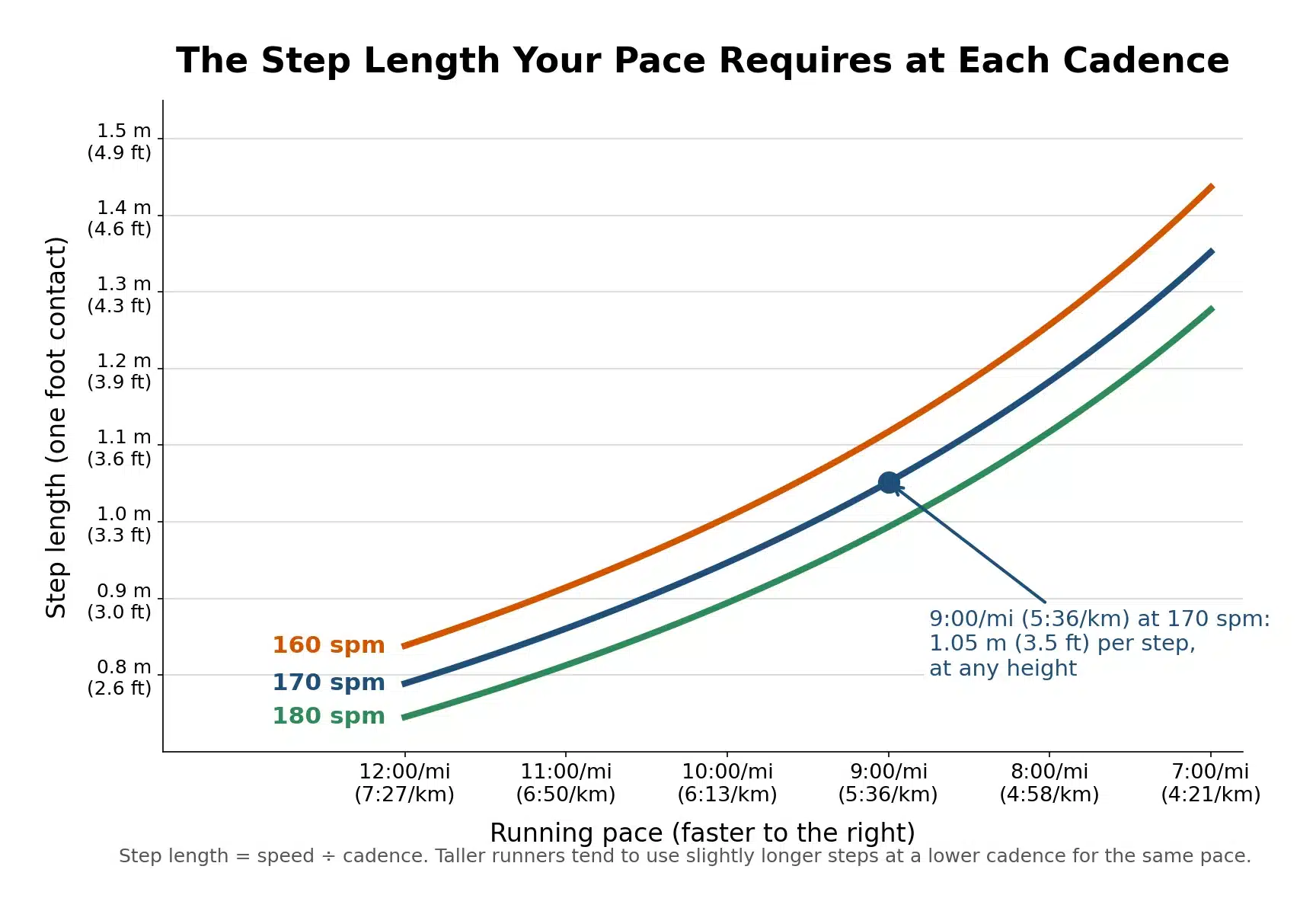
There isn’t a very best stride size for a given peak, as a result of your step size is about by your tempo and your cadence.
Your working pace equals your step size multiplied by the variety of steps you are taking every minute.
So if your tempo and your cadence, you may work out your step size with out measuring something.
A step is one foot contact, and a stride is 2 steps (left plus proper), which is why stride size numbers run about double step size numbers.
Right here is the step size every widespread tempo requires at 3 totally different cadences.
Tempo
Step size at 160 steps/min
Step size at 170 steps/min
Step size at 180 steps/min
11:00/mi (6:50/km)
0.91 m (3.0 ft)
0.86 m (2.8 ft)
0.81 m (2.7 ft)
10:00/mi (6:13/km)
1.01 m (3.3 ft)
0.95 m (3.1 ft)
0.89 m (2.9 ft)
9:00/mi (5:36/km)
1.12 m (3.7 ft)
1.05 m (3.5 ft)
0.99 m (3.3 ft)
8:00/mi (4:58/km)
1.26 m (4.1 ft)
1.18 m (3.9 ft)
1.12 m (3.7 ft)
7:00/mi (4:21/km)
1.44 m (4.7 ft)
1.35 m (4.4 ft)
1.28 m (4.2 ft)
For example, a runner at 9:00/mi (5:36/km) and 170 steps per minute covers 1.05 meters (3.5 ft) with each step, whether or not they’re 5’4″ or 6’2″.
Your tempo and cadence set your step size, so no peak system can hand you a perfect stride size.
Your physique additionally picks a step size near essentially the most economical one for you.
A 1982 research had 10 runners lengthen and shorten their stride by as much as 20% of leg size at 7:00/mi (4:21/km).
Each runner had a stride size the place oxygen use was lowest.
Their freely chosen stride used simply 0.2 ml of oxygen per kilogram per minute greater than their greatest stride.
On the shortest and longest extremes, the additional oxygen use rose to 2.6 to three.4 ml per kilogram per minute.
Which means your pure stride is already near your most economical one. Forcing it to match a height-based system is extra more likely to increase your oxygen use than decrease it.
Does Tempo Change Your Stride Extra Than Peak?
Rushing up raises each your step size and your cadence, however step size does a lot of the work.
Within the 256-runner watch research, stride frequency rose by about 6 steps per minute for each 1 meter per second of additional pace.
Going from 10:00/mi (6:13/km) to eight:00/mi (4:58/km) is 0.67 meters per second quicker, which provides solely about 4 steps per minute.
The elite ultramarathoners confirmed nearly the identical pace impact, so 10 cm of peak was linked to about 3 instances extra cadence distinction than that 2-minute-per-mile tempo change.
Which means a peak hole between 2 runners can outweigh a standard tempo change, and it is best to nonetheless examine your individual cadence on the identical tempo from run to run.
Ought to Tall Runners Nonetheless Increase Their Cadence?
Should you’re injury-prone otherwise you overstride, a small cadence enhance is value testing no matter your peak.
Taking faster steps on the identical tempo shortens every step, and your knee bends much less every time your foot takes your weight.
A 2011 research of 45 runners discovered {that a} 5% step charge enhance diminished the vitality the knee absorbed with every touchdown.
A ten% enhance additionally diminished the vitality absorbed on the hip.
The identical runners additionally bounced much less, as a result of the vertical motion of their middle of mass dropped as their step charge rose.
Elevating step charge by 10% on the identical pace reduce the height pressure on the kneecap joint by 14%.
That 2014 research modeled the knee forces of 30 wholesome adults at 90%, 100% and 110% of their most well-liked step charge.
Much less knee bend beneath load was the strongest predictor of the drop in pressure.
Which means a faster cadence is value testing in case you have a protracted, reaching stride, since overstriding is the behavior it corrects.
The proof on accidents is thinner than the proof on forces.
A 2022 assessment of 37 research discovered sturdy proof that elevating step charge reduces knee bend beneath load.
The identical assessment discovered solely very restricted proof that it improves ache.
It additionally discovered very restricted proof {that a} increased step charge raises perceived effort and vitality use, largely in same-day assessments.
In a 2019 case sequence with no management group, 12 runners with kneecap ache and extra hip and pelvis motion raised their step charge by 10%.
At follow-up, they reported much less ache and have been working about 13.8 km (8.6 miles) extra per week.
Newer runners have essentially the most room to achieve.
A 2014 research discovered that novice runners selected a stride frequency about 8% under the one which used the least oxygen, whereas educated runners selected one simply 3% under theirs.
Which means for those who’re new to working, your pure cadence is extra more likely to be too low on your personal physique, no matter your peak.
How Do You Increase Your Cadence With out Losing Power?
Increase your cadence in steps of 5% or much less. Choose every step by your coronary heart charge at a hard and fast straightforward tempo as an alternative of a goal like 180 steps per minute.
Measure your present cadence. Depend each time your proper foot lands for 30 seconds on a simple run, then multiply by 4, or learn the common cadence out of your watch.
Report it at a set tempo. Word the tempo you measured it at, since your cadence rises a bit of as you pace up.
Add 5%. A runner at 160 steps per minute strikes to 168 steps per minute, and a runner at 170 steps per minute strikes to about 178 steps per minute.
Follow in 1-to-2-minute blocks. Run 3 to five of those stretches on the new cadence throughout straightforward runs, utilizing a metronome app set to your goal or music with an identical beat.
Verify your coronary heart charge. In case your coronary heart charge on the identical straightforward tempo is unchanged or decrease after 2 to three weeks, hold the brand new cadence. If it has climbed, maintain your present cadence longer earlier than including extra.
The guts-rate test comes from the 2014 research of novice and educated runners.
In a single treadmill session, the stride frequency that gave the bottom coronary heart charge matched the one with the bottom oxygen use.
Your cadence additionally tells you solely a lot about how nicely you run.
A 2024 assessment of 51 research discovered that runners with a better cadence tended to make use of rather less vitality on the identical pace.
Even the strongest type measures, like bounce and leg stiffness, defined solely 4% to 12% of the distinction in working financial system between runners on their very own.
Which means you will discover your individual optimum stride charge and cease there, with out forcing your cadence towards another person’s quantity.
Making a brand new cadence final takes development and repetition. Our Enhance Operating Type course walks you thru the drills, power work and cues that construct your individual most effective stride over weeks.
RunnersConnect Bonus
Obtain your FREE Information to Minimalist Operating.
Supplying you with a simple to comply with, printable pointers for modify your coaching, slowly add-in barefoot working, and the precise power routine it is advisable get your ft wholesome and robust!
GET MY GUIDE
Is It Higher to Be Tall or Brief for Operating?
On the elite marathon stage, the quickest runners have trended shorter and lighter, however that pattern tells you little about your individual progress.
A 2014 evaluation tracked the world’s 100 greatest marathoners, males from 1990 and girls from 1996, via 2011.
Their peak, physique weight and physique mass index all decreased whereas marathon instances stored bettering.
The identical evaluation discovered a curved relationship between physique mass index and working pace, fairly than a straight line, so lighter was not all the time quicker.
Which means peak and construct matter most on the entrance of an elite race, and for on a regular basis runners your coaching is the half you may change.
How Do Peak, Stride Size and Cadence Match Collectively?
Right here’s a fast reference for the way peak and the remainder of your stride match collectively.
Query
What the analysis discovered
What to do
Does peak decrease cadence?
About 12 fewer steps per minute per 10 cm of peak in elite runners, with a 155 to 203 steps-per-minute vary
Anticipate a decrease cadence for those who’re tall, then measure your individual
Is there a stride size for my peak?
Step size equals pace divided by cadence, and freely chosen strides value simply 0.2 ml/kg/min extra oxygen than one of the best stride
Use the tempo desk and skip peak formulation
Does tempo matter extra?
About 6 additional steps per minute per 1 meter per second of pace
Evaluate cadence on the identical tempo
Ought to tall runners increase cadence?
A ten% enhance reduce peak kneecap joint pressure by 14%
Attempt it for those who overstride or get knee ache
How briskly ought to I alter it?
Novices selected a cadence about 8% under their most economical one
Add 5% at a time and test coronary heart charge at a hard and fast straightforward tempo