Abstract
The push kick, identified in Thai because the teep, is essentially the most versatile and arguably a very powerful approach in Muay Thai. Just like the jab in boxing, it’s the basis on which the remainder of a fighter’s sport is constructed: a instrument for measuring vary, disrupting rhythm, controlling distance, inflicting injury, and organising each different weapon within the arsenal. However not like the jab, which is restricted to a single putting floor at a single vary, the teep will be thrown from both leg, focused to a number of ranges, used offensively and defensively in the identical trade, and disguised with feints and fakes that make it genuinely unpredictable. This text goes past the mechanics to cowl the total vary of push kick purposes: disrupting rhythm and stopping ahead momentum, utilizing it defensively to manage vary, deploying it as a real offensive weapon off each legs, utilizing fakes and feints to create openings throughout the physique, selecting targets strategically, and recovering cleanly when the kick is caught. As Muay Thai World Champion and Evolve MMA teacher Chaowalit Jocky Fitness center places it, “The teep is the approach that tells me who understands Muay Thai and who remains to be studying it. Anybody can throw a tough kick. However a fighter who makes use of the teep to manage the gap, arrange their opponent, and disrupt all the pieces the opposite particular person is making an attempt to do — that fighter is pondering. And in Muay Thai, the fighter who thinks wins.” Grasp each utility on this information and the teep will grow to be the centre of your total putting sport.
Key Takeaways
The push kick is as elementary to Muay Thai because the jab is to boxing. It’s not only a range-finding instrument; it’s a weapon that may disrupt rhythm, management distance, inflict injury, rating knockdowns, arrange different strategies, and create openings by feints, all from a single foundational motion.
Method integrity is non-negotiable no matter which utility you’re utilizing. A lazy teep, one thrown with out the proper hip drive, knee carry, and arm swing, loses energy, compromises your steadiness, and creates a counter alternative for a pointy opponent. Each utility on this article will depend on the fundamentals being persistently maintained.
The entrance leg teep and rear leg teep serve distinct functions and shouldn’t be handled as interchangeable. The entrance leg teep is quicker, perfect for vary discovering, rhythm disruption, and defensive use towards an advancing opponent. The rear leg teep is extra highly effective, higher suited to offensive affect and creating decisive backward motion. Growing each to a excessive commonplace offers you a whole teep sport.
Feints and fakes constructed on the teep’s motion sample multiply the approach’s effectiveness dramatically. An opponent who has been teeped repeatedly will start to react defensively to the knee carry, and that response turns into a gap. The faux knee-to-rear-knee, the pivot angle minimize, the leaping change, and the feint-to-elbow are all constructed on the credibility the actual teep has established.
Goal choice shapes what the teep achieves. A teep to the abdomen disrupts respiratory and stamina over time. A teep to the chest impacts steadiness and creates backward motion. A teep to the thigh or hip disrupts rhythm and stops ahead momentum. Understanding which goal serves which function and deciding on accordingly is the distinction between utilizing the teep tactically and utilizing it mechanically.
Catching the teep is much less of a menace than most fighters assume, supplied approach is sound. Placing with the balls of the toes and withdrawing the leg shortly leaves minimal time for an opponent to understand the foot. Even in a worst-case catch situation, particular escapes — persevering with to kick and push away, or turning and flexing the knee to slip free — restore place with out important hazard.
Don’t Overlook The Fundamentals
For those who’ve skilled Muay Thai for some time, you need to be conversant in the mechanics of the push kick following hundreds of reps on the bag. Nevertheless, don’t let that be an excuse to relaxation in your laurels and overlook to take care of the proper kind once you throw your strikes.
Forgetting any of those core push-kick rules will compromise your steadiness and energy, or open you as much as a counter.
Straighten your standing leg as you increase your kicking leg.
Elevate your knee up excessive earlier than you kick.
Prolong our hips, snap your kick ahead and swing the arm on the identical aspect as your kick to maximise energy.
Maintain your chest again, chin down, and reverse arm as much as shield your self.
Return to a powerful stance. That normally means you need to be in the identical place as once you began.
Don’t step along with your again foot once you kick along with your entrance leg – your opponent will see you make the primary transfer and be capable to anticipate what’s coming.
Now that you simply’ve refreshed your reminiscence, check out the principle purposes to your push kicks.
1) Disrupting Rhythm
The great thing about the push kick is that it may be as delicate as it’s damaging. A exact assault can provide you a number of advantages with out an excessive amount of effort.
A agency front-leg push kick in your opponent’s lead thigh or hip can simply disrupt their rhythm and set them as much as soak up your offense. Higher but, in the event you can time these focused push kicks as they transfer ahead, you’ll cease their ahead momentum.
Even in the event you don’t take your probability to assault instantly, you’ll nonetheless have made some helpful strikes. The extra your opponent has their assaults stopped or has to reset, the extra pissed off they might get. In the event that they’re an inexperienced competitor, that might result in them sacrificing kind and approach to try to land one thing, providing you with an ideal probability to strike again decisively.
2) Protection & Controlling Distance
This facet of the push kick will not be going to finish up on many spotlight reels, nevertheless it’s super-important. Similar to a boxer can use their jab to measure distance and discover their vary, Muay Thai fighters can do the identical with their front-leg push kick.
Your lead leg is an much more helpful instrument than your lead hand as a result of you’ve got way more house to play with. For those who can land a push kick along with your entrance leg, you’ll know you’re in vary to throw a tough roundhouse kick. You’ll additionally see how shut you’re to punching vary whereas crucially hovering simply outdoors your opponent’s punching vary.
A key component of discovering your vary with this technique is to take care of integrity along with your strikes. Don’t sacrifice approach and throw out a lazy kick. Not solely will you not maximize the size of your kick, however your rival can even have an opportunity to capitalize in the event that they’re sharp with a counter that packs way more depth.
Your entrance push kick can also be arguably your handiest defensive weapon towards an oncoming opponent, too – particularly if they’re getting into boxing vary. As your rival strikes ahead, jabbing your entrance foot into their torso will cease them useless of their tracks. The secret is to good your kind, so that you push your adversary again with out transferring again your self. The end result shall be that you simply create house and even knock your assailant onto the canvas.
This easy defensive maneuver can do some injury, too. Because the opposing forces of your foot and their midsection collide, you’ve received an excellent probability of knocking the wind out of your opponent, which can compromise their protection whereas they get well and even pressure them to take a knee.
You may obtain an identical end result with extra energy utilizing a rear-leg push kick. Nevertheless, it takes way more time to your again leg to journey ahead and land on its goal than it does to carry and land along with your entrance leg, so it is perhaps extra useful to give attention to perfecting strikes along with your entrance leg.
3) Offense
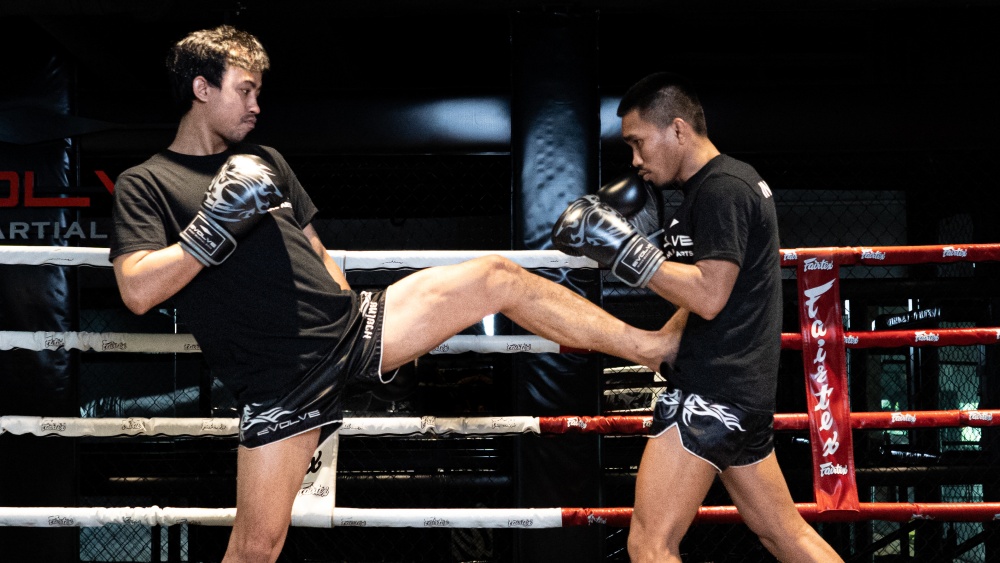
Similar to a jab, the push kick can do some critical injury, too. When it’s used as an offensive weapon off both leg, your opponent may very well be despatched flying throughout the ring and even be knocked out. The way in which Buakaw Banchamek dismantled Masato of their first Okay-1 World Grand Prix Last match exhibits simply how devastating a sustained push-kick assault will be.
Your rear leg is your go-to for push kick energy. It’s going to generate a whole lot of energy on the lengthy journey in your energy aspect and be naturally stronger, so in the event you can join with it, you’re nearly assured to knock your opponent backward or down onto the mat.
One disadvantage to main along with your again leg is that the strike shall be straightforward to see coming. For those who’re going through a rival who’s extra switched-on, it is perhaps greatest to set it up, however since you’re at lengthy vary, punches is not going to do the trick. A good suggestion is to faux a spherical kick to get them to give attention to defending their left aspect and open a spot down the centerline so that you can exploit by switching to a push kick.
In order for you most energy out of your entrance leg, the aspect push kick is the best way to go. This method was the trademark of one of many biggest Muay Thai fighters of all time, Samart Payakaroon.
Due to the side-on stance used to throw this system, you may cowl extra distance and strike extra explosively down the centerline than with a standard front-leg teep. You may even throw it if an opponent has slipped one in every of your roundhouse kicks. Plus, it’s a faster strike than the back-leg push kick. Nevertheless, lacking your mark means you’ll most likely land off-balance and out of place, having expended a ton of power, leaving you huge open for a counter-attack. For that cause, this can be a high-risk strike it’s best to solely use in competitors when you’ve got perfected it.
Regardless of the pressure you may generate from these two strategies, it’s essential to not low cost the entrance push kick as an efficient offensive weapon. One take a look at the best way Sam-A Gaiyanghadao skips ahead to generate additional energy and stabs his proper foot into rivals exhibits what a devastating instrument it may be. For those who don’t put your opponent down, it’s an ideal first strike to set them up for an much more harmful shot.
4) Fakes & Feints
One other key facet of those push kick strategies is understanding when to not throw them, and how one can merely threaten with them to catch your challenger off-guard.
For those who’ve spent a spherical sticking your entrance foot into your rival’s midsection, the probabilities are that they’ll give attention to making an attempt to keep away from or counter your push kick. That may go away them huge open to an alternate assault.
The primary method to combine issues up is to faux by lifting your knee. Then, as an alternative of kicking, plant your entrance foot on the mat, and comply with by with a rear knee.
Alternatively, faux by lifting your knee, step out to the aspect, and pivot to chop an angle that’s good for throwing a spherical kick.
In case your opponent is dropping their arms to attempt to catch or sweep your leg, they’re leaving their head unguarded, so you may faux the kick in the identical means, skip ahead, and throw an elbow at an open goal.
No matter method you’re taking, it’s essential to carry your knee excessive as in the event you have been actually going to throw a push kick to pressure a response. In case your knee doesn’t come above your waist as it will in the event you have been attacking for actual, it’s unlikely your opponent will flinch, and you could simply run into bother.
Essentially the most spectacular method to present one leg and strike with the opposite is the leaping change push kick, which distracts your rival along with your entrance leg earlier than you utilize your momentum to launch a full-power rear push kick. For those who’ve watched the legend Saenchai compete, you’ve most likely seen it in motion and needed to attempt it your self, however watch out. Just like the aspect push kick, this can be a high-percentage transfer that takes the form of talent and timing that Saenchai has honed over a long time of competitors, so don’t use this high-flying maneuver in a battle with out in depth drilling.
Your rear-leg push kick will not be fairly as versatile in relation to fakes, however it might probably definitely be used to arrange some fight-finishing strikes. As soon as your adversary begins to anticipate to defend this system, you may change issues up midway by – present them your knee, then march ahead as an alternative of thrusting your foot ahead. You’ll find yourself in your reverse stance, the place you may throw a strong kick, knee, or cross, relying in your vary.
Select Your Goal
Most of your push kicks will goal your opponent’s torso. It’s an enormous goal to purpose for, which suggests you’ve got an excellent probability of at the very least connecting with one thing.
The most typical goal might be the abdomen. Even when your rival has abs of metal, that is the softest a part of the torso to purpose for. Repeated blows can have a serious impact on their respiratory and stamina because the battle goes on. In case your strikes are timed completely as they breathe in, you possibly can wind them and rating a knockdown. Touchdown increased up on the chest offers you a greater probability of affecting your rival’s steadiness, transferring them backward, and knocking them down.
It’s much less frequent to see a push kick to the face, nevertheless it’s attainable, very efficient for disruption, and has the potential for scoring a knockout. Nevertheless, a entrance kick to the face is seen as disrespectful in Thailand – even in a battle – and also you positively don’t need to put your soles in your teammates’ faces in coaching!
Counter A Catch
One of many principal causes the push kick is underused in MMA is strikers’ fears of getting their kicks caught. Nevertheless, in case your approach is sweet, it’s best to be capable to evade your opponent’s grasp.
For those who ensure you strike with the balls of your toes, then withdraw your leg shortly, you’ll go away little or no alternative to your rival to seize your foot.
Within the worst-case situation, you may get well place after a catch with out too many issues with a few escapes. First, you may proceed to teep and kick your means out. By digging your hip into your opponent’s ribs and pushing away, it’s best to be capable to break away. Alternatively, you may level your toes, flip midway towards your reverse aspect, then flex your knee to take your foot away and land again in your combating stance. With sufficient pressure, it’s best to slide proper out.
If all else fails and your opponent strikes again, cowl up!
Continuously Requested Questions About The Muay Thai Push Kick
Q: What Is The Distinction Between A Teep, A Push Kick, And A Entrance Kick?
A: Teep, push kick, and entrance kick all confer with the identical elementary approach, a forward-thrusting kick delivered with the ball or sole of the foot to create distance, disrupt rhythm, or inflict injury. The time period teep is the Thai identify for the approach. Push kick and entrance kick are English-language descriptions utilized in completely different coaching contexts. In apply, the phrases are used interchangeably by most coaches and practitioners, although some distinguish a entrance kick as extra of a snapping, penetrating movement and a push kick as emphasising the pushing, distance-creating high quality of the approach. For the needs of aggressive Muay Thai, all three names describe the identical instrument.
Q: Why Is The Entrance Leg Teep Quicker Than The Rear Leg Teep?
A: The entrance leg teep is quicker as a result of it travels a shorter distance to achieve the goal. Positioned nearer to the opponent by advantage of being the lead leg, it requires much less time to chamber, lengthen, and join than the rear leg, which should journey the total width of the fighter’s stance earlier than it even begins its ahead extension. This pace benefit makes the entrance leg teep the popular instrument for vary discovering, defensive use towards advancing opponents, and rhythm disruption — conditions the place the pace of the kick issues greater than its energy. The rear leg teep sacrifices that pace for considerably better energy, making it extra applicable for offensive purposes the place the aim is to maneuver the opponent backward decisively or create a ending alternative.
Q: How Do I Cease Telegraphing My Push Kick?
A: The most typical telegraph of the entrance leg teep is stepping with the rear foot earlier than the kick — a preparatory weight shift that offers the opponent a visual sign {that a} kick is coming. The article above particularly addresses this: don’t step along with your again foot when kicking along with your entrance leg. The second commonest telegraph is a visual rigidity or postural change earlier than the kick chambers. The answer to each is to practise the kick in order that the chamber begins with none preparatory motion — the knee rises straight out of your combating stance with none previous adjustment. Hundreds of gradual, deliberate reps in shadowboxing and on the bag, with particular consideration to minimising the visible sign earlier than the knee rises, is the best method to make the teep genuinely tough to learn.
Q: How Ought to I Use The Push Kick Successfully In opposition to A Taller Opponent?
A: Taller opponents sometimes use the teep to maintain shorter opponents on the finish of their longer attain — a irritating dynamic that the shorter fighter should resolve actively. The best approaches are: closing distance in a means that takes you inside their teep vary earlier than they will fireplace it — such because the Muay Thai hop or a fast lateral step to vary the angle of method; utilizing your individual entrance leg teep to parry or deflect theirs earlier than it lands; and ranging your angles in order that the straight-line teep that fits their longer attain is much less obtainable. The thigh and hip teep talked about within the article is especially helpful towards taller opponents as a result of it targets decrease on the physique the place their attain benefit is much less pronounced and their verify is much less computerized.
Q: Can The Push Kick Be Used Successfully In MMA, And How Does The Utility Differ?
A: Sure — and it’s more and more frequent on the highest ranges of MMA exactly due to its effectiveness at controlling distance and disrupting the rhythm of opponents who depend on closing the hole to provoke takedowns. The first adaptation for MMA is consciousness of the catch-and-takedown: a caught teep in MMA can result in a takedown slightly than merely a leg seize, which adjustments the chance profile of the kick. The technical answer is similar as in Muay Thai — putting with the balls of the toes and withdrawing shortly — however the urgency of that withdrawal is increased in MMA. The entrance leg teep, due to its pace and the minimal dedication it requires, is mostly thought-about safer in MMA than the rear leg teep. Many MMA practitioners additionally use the teep as an anti-wrestling instrument — firing it into an advancing opponent who’s reducing their stage for a takedown try.
Q: How Do I Construct Real Energy In My Rear Leg Push Kick?
A: Rear leg push kick energy comes from three major sources: hip extension, leg drive, and the momentum generated by the arm swing on the identical aspect because the kicking leg. Hip extension — thrusting the hips ahead because the leg extends — is a very powerful of the three and the element mostly underemphasised. Fighters who merely lengthen the leg with out the hip drive produce a push kick that’s gradual and restricted in energy. Mixed with the total drive of the leg and the counter-swing of the arm, the hip extension converts the kick from a leg motion right into a whole-body motion that generates considerably extra pressure. Heavy bag work with deliberate consideration to the hip drive in each rep — slightly than merely finishing the rep — is the best method to construct this high quality.
Q: What Is The Aspect Push Kick And When Ought to I Use It?
A: The aspect push kick is a variation by which the fighter turns their physique to a extra side-on angle earlier than delivering the entrance leg teep — a method related to the legendary Samart Payakaroon. The side-on stance permits the fighter to cowl extra distance down the centreline and generate extra explosive pressure than the usual front-leg teep, whereas additionally being faster than the rear-leg push kick. It’s notably efficient when an opponent has slipped one in every of your roundhouse kicks and is caught momentarily off-balance. The numerous disadvantage is that lacking the goal with the aspect push kick leaves you off-balance, out of place, and having spent appreciable power, making it a high-risk approach that requires in depth drilling earlier than it ought to be deployed in competitors. It’s not a method for learners or for an off-the-cuff introduction to sparring.
Q: How Do I Escape Cleanly When My Push Kick Is Caught?
A: The primary precedence is to keep away from the catch within the first place by putting with the balls of the toes and withdrawing the leg shortly — the much less time the foot is close to the opponent’s arms, the smaller the window for a catch. If the kick is caught regardless of right approach, two major escapes can be found. The primary is to proceed making use of pressure with the caught leg — dig your hip into the opponent’s ribs and push aggressively away, which breaks the grip by pressure slightly than finesse. The second is to level your toes, flip your physique midway towards the alternative aspect, and flex your knee to slip the foot free, touchdown again in your combating stance. Each escapes depend upon reacting shortly earlier than the opponent can consolidate their grip and provoke their follow-up. If neither escape succeeds and the opponent strikes, cowl up and shield your head.
Last Ideas
The push kick is a type of strategies that reveals extra depth the longer you research it. Most learners perceive it as a range-finding instrument. Intermediate fighters start to make use of it defensively and to disrupt rhythm. Superior fighters deploy it offensively, use feints constructed on its motion sample to create openings throughout all the physique, and choose targets with tactical precision based mostly on what the battle requires at that particular second.
The journey from newbie teep to actually harmful teep is lengthy — nevertheless it is among the most rewarding technical investments in Muay Thai as a result of each enchancment to the teep instantly improves each different approach constructed on high of it. Higher hip drive means a extra highly effective roundhouse. Higher knee carry means extra convincing feints. Higher restoration means extra combos.
Drill it greater than feels mandatory. Research how elite fighters like Saenchai, Sam-A Gaiyanghadao, and Buakaw Banchamek have constructed total battle methods round its purposes. Deliver each variation into your sparring with a particular intention every spherical. The push kick will repay that funding at each stage of your Muay Thai journey.
You might also like:
Important Solo Muay Thai Drills For All Ranges