
You began working a number of weeks in the past, and now your legs damage in methods they by no means did earlier than.
Your calves really feel like concrete the morning after a run, and your quads ache each time you head down stairs.
A uninteresting soreness settles into your shins, and also you catch your self questioning whether or not you might be getting fitter or breaking one thing.
That fear is the true downside, as a result of it’s exhausting to coach when you’ll be able to’t inform an on a regular basis ache from the primary signal of an harm.
The excellent news is that the majority of what new runners really feel is regular and short-lived, and some dependable alerts inform you when it isn’t.
So, on this article we’re going to have a look at:
Why your legs get so sore whenever you first begin working
inform regular soreness aside from an harm that wants consideration
When the soreness fades, and how you can get better and preserve it from derailing your coaching
Why Do Your Legs Damage After You Begin Working?
Laborious or unfamiliar working makes your muscle groups sore as a result of it causes tiny quantities of bodily harm contained in the muscle fibers, and your physique repairs that harm so the muscle can deal with the identical load subsequent time.
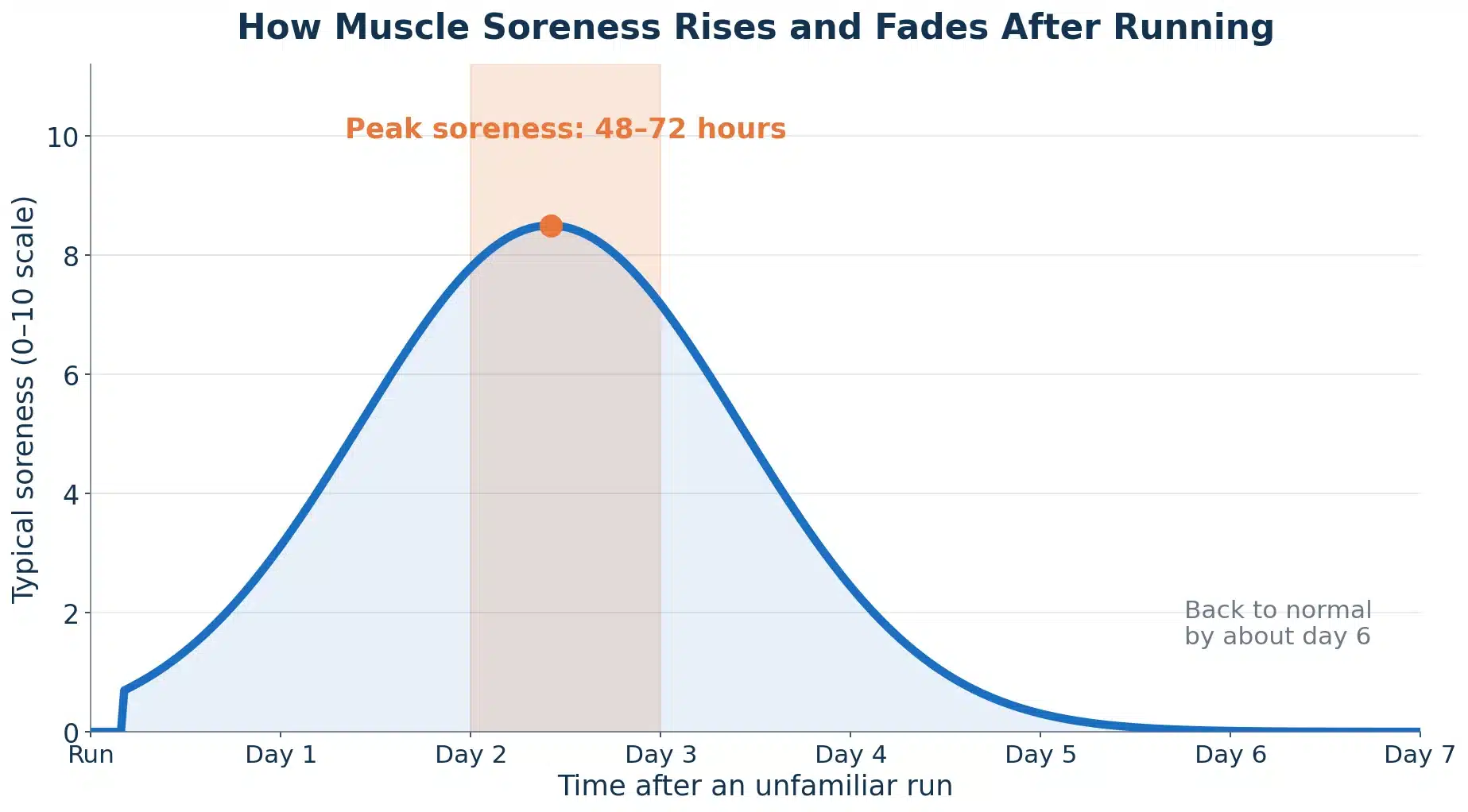
Analysis on muscle soreness courses it as a gentle muscle harm from eccentric or unfamiliar train, with the soreness peaking 48 to 72 hours after you run.
The soreness comes from eccentric contractions, which occur when a muscle lengthens whereas it’s nonetheless working, like when your quads soak up influence on each downhill step.
These contractions create microscopic tears within the muscle, and as your physique repairs them it produces irritation, which is the stiffness and ache you are feeling a day or 2 later.
This harm sounds alarming. However it’s the regular sign that your physique is adapting to a requirement it has not met earlier than.
It additionally explains the delay that confuses so many new runners, as a result of the run itself can really feel positive whereas the worst soreness arrives 2 days afterward.
An early assessment of train soreness discovered that the drop in power and luxury is non permanent and leaves no everlasting harm, so the heavy-legged feeling passes because the muscle rebuilds.
The place Do New Runners Really feel the Soreness Most?
A couple of spots take the brunt of your first weeks of working, and understanding which is which tells you the way a lot to fret.
Your calves and quads lead the checklist. They soak up essentially the most influence and do essentially the most eccentric work on each stride.
That soreness spreads throughout the entire muscle, exhibits up on each legs, and fades over a number of days, which is the traditional signature of regular adaptation.
The entrance of your shins is the realm to keep watch over, as a result of a deep ache alongside the shin bone could be early shin splints moderately than extraordinary soreness.
Shin ache that stays sharp, sits on one leg, or hurts whenever you press alongside the bone is price resting and checking, because it is likely one of the overuse accidents that catch new runners most frequently.
Your knees and hips can really feel stiff early on as effectively, although ache that locks into one joint and worsens run over run belongs within the harm column moderately than the soreness one.
Is Soreness After Working Regular, or a Signal of Harm?
Regular soreness and a creating harm really feel totally different in 3 methods you’ll be able to verify after any run.
The primary is location, as a result of basic muscle soreness often exhibits up on either side of your physique without delay.
When each calves or each quads ache evenly, that even, two-sided ache factors to extraordinary adaptation moderately than harm.
Pay nearer consideration to ache in a single spot on a single leg, above all when it sits on a joint, a bone, or a tendon.
You can too watch how the discomfort behaves when you transfer.
Regular soreness eases when you heat up and preserve working, whereas an harm sharpens because the run goes on.
Ache that grows throughout a run and forces you to alter your stride is the clearest signal to cease and deal with it as an harm moderately than soreness.
Lastly, watch the clock, as a result of muscle soreness follows the 2-day sample after which fades, whereas harm ache lingers, returns to the identical spot, or exhibits up sharply the second you begin.
On a regular basis soreness ought to nonetheless allow you to stroll usually and get via your day, even for those who really feel stiff.
RunnersConnect Bonus
Obtain your FREE Harm Evaluation and Prediction Video now.
A very good harm prevention program begins with assessing the place you’re weak and the place you is likely to be tight or inhibited. Within the video I’ll show the six mobility exams it is advisable to carry out to evaluate what it is advisable to start engaged on.
Get My Video Now
When Does Working Cease Hurting?
The soreness fades sooner than most novices count on, as a result of your muscle groups adapt rapidly to the particular demand of working.
Your first few runs produce the worst soreness, and every related run after that produces much less.
Muscle researchers name this the repeated bout impact, the place a single bout of train protects the muscle in opposition to harm and soreness from the bouts that comply with.
The safety builds quick, which is why the simple run that flattened you firstly barely bothers you a month in.
Most new runners discover the sharp, widespread soreness settles inside the first 2 to three weeks of constant working.
The sooner assessment of soreness reached the identical sensible level, that repeating the exercise that made you sore is what trains the soreness away.
Which means the quickest route via the sore part is regular, repeatable working moderately than one heroic effort adopted by per week off.
Ought to You Run By way of Soreness, or Relaxation?
You possibly can often preserve working via extraordinary soreness, so long as you decide it by how the ache behaves moderately than by whether or not it’s current in any respect.
Researchers constructed a easy pain-monitoring mannequin to reply precisely this query.
In a managed trial of runners with sore tendons, the group that saved working whereas holding ache to a suitable stage recovered simply in addition to the group that stopped utterly.
The mannequin makes use of a 0 to 10 ache scale, the place discomfort as much as about 5 is appropriate in the course of the run if it settles by the following morning.
Maintain working when soreness stays reasonable and calms down in a single day, and again off when ache climbs previous a 5, lingers into the following day, or worsens run over run.
On a sore day, that often means a simple run at a conversational effort moderately than a tough exercise.
Slowing down retains you shifting and adapting with out including new harm to muscle groups which can be nonetheless repairing.
How Doubtless Are You to Get Injured as a New Runner?
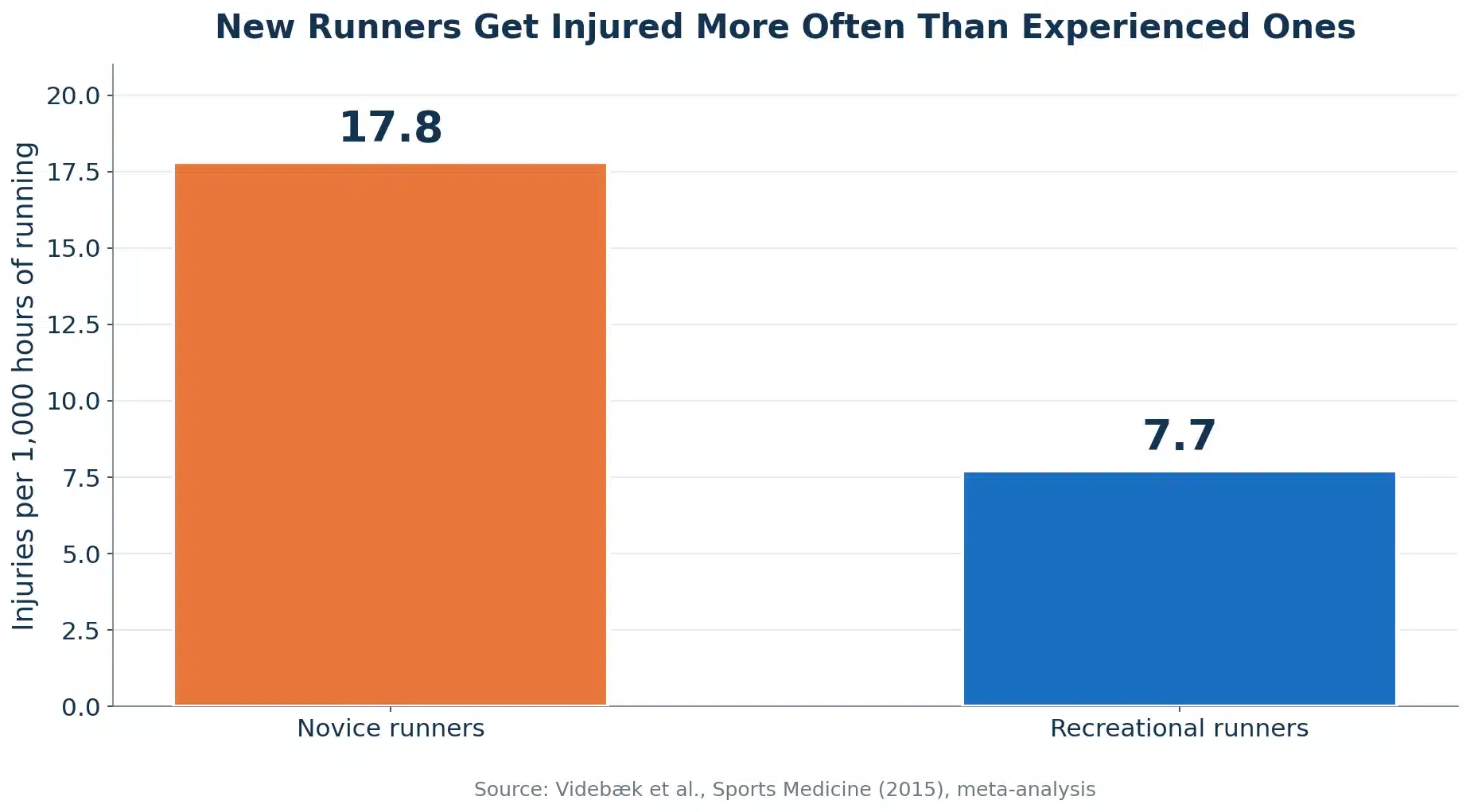
New runners do get injured extra usually than skilled ones, which is price understanding so you’ll be able to respect the chance with out fearing each ache.
A assessment of harm charges in runners discovered 17.8 accidents per 1,000 hours of working in novices, in opposition to 7.7 per 1,000 hours in leisure runners.
New runners get damage for a easy cause: your muscle groups and connective tissue want weeks to strengthen, and doing an excessive amount of earlier than they do is what results in harm.
Most working accidents construct up step by step from doing an excessive amount of too quickly.
The strongest factor you are able to do about that danger is to boost your working quantity slowly and provides your physique weeks, not days, to adapt.
Our information to rising your weekly mileage safely lays out how a lot so as to add and the way usually.
How Do You Get well From Sore Legs After Working?
The very best short-term repair for sore legs is mild motion.
The soreness assessment discovered that mild exercise relieves the ache higher than sitting nonetheless, despite the fact that the soreness returns for some time afterward.
A straightforward stroll or a sluggish, brief run will increase blood circulation to the muscle and eases the stiffness with out including actual pressure.
Maintain shifting gently on sore days, sleep sufficient to provide the muscle time to rebuild, and eat sufficient protein and carbohydrate to provide the rebuild with uncooked materials.
House your exhausting efforts so a sore muscle will get a day or 2 to get better earlier than you tax it once more.
For extra methods to hurry up the method, our roundup of how you can eliminate muscle soreness after a run covers the strategies that assist most.
Dealt with this manner, the sore newbie part turns into a brief chapter moderately than a cause to stop.
Sign
Regular soreness
Doable harm
Location
Each legs, unfold throughout the muscle
One spot on one leg, usually a joint or bone
Through the run
Eases as you heat up
Sharpens and alters your stride
Timing
Peaks 48 to 72 hours, then fades
Lingers, returns, or hits sharply firstly
Day by day life
Stiff however you progress usually
Limits regular strolling