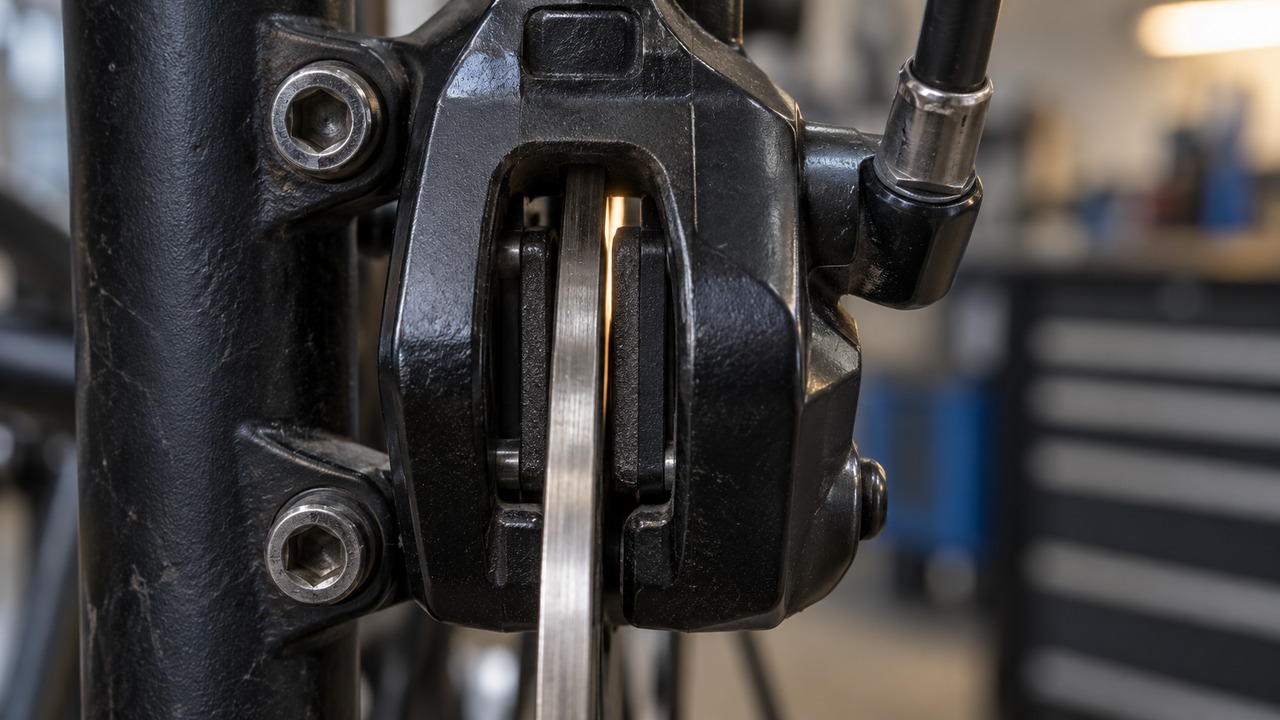
A disc brake that rubs all the best way spherical has a caliper sitting off-center over the rotor; loosen the 2 caliper bolts, squeeze the lever and retighten them. If the rub comes and goes as soon as per wheel flip, the rotor is bent in a single spot and wishes truing. If it began after you swapped wheels or fitted new pads, examine that the axle is totally seated and that the pistons went all the best way again earlier than you contact anything.
Squeal and squeak underneath braking are a separate drawback: see why bike brakes squeak. Figures and quotes under come from Shimano, SRAM and Park Device and are named the place they seem; some other rule right here is Icebike’s personal reasoning from how the elements work.
Match the rub to the trigger
Raise the wheel and spin it by hand. A gentle hiss means fixed contact; a “shh, shh” in time with the wheel means one spot on the rotor.
What you discover
Possible trigger
Fast examine
Repair
Rubs all the best way spherical, identical sound the entire flip
Caliper off-center, or a wheel not totally seated
Backlight the caliper: one pad hole reveals no gentle
Reseat the wheel, then heart the caliper
Rubs on one facet solely
Caliper off-center; on hydraulics, one sticky piston
Squeeze the lever and launch: does one pad keep out?
Heart the caliper; if a pad stays out, reset the pistons
Rubs in a single spot, as soon as per wheel flip
Bent rotor, or a free rotor
Watch the hole open and shut because the rotor passes the pads
Tighten the rotor bolts or lockring, then true the rotor
Began after a wheel change
Axle not seated, or the brand new wheel holds its rotor in a unique place
Reseat the wheel; if it nonetheless rubs, the rotor place differs
Heart the caliper for that wheel
Began after a pad change
Pistons not totally pushed again, or caliper now off-center
Are each pistons flush and shifting evenly?
Reset the pistons, pump the lever, then heart the caliper
Hydraulic: each pads drag, usually after the lever was squeezed with the wheel out or after a bleed
Pistons pushed out too far, or additional fluid within the system
The rotor gained’t slide between the pads, or the pads gained’t push again by hand
Reset the pistons with the reservoir open
Scraping or grinding after a moist or muddy experience
Grit or a stone between pad and rotor, or contaminated pads
Pull the wheel and take a look at the pad faces
Clear the rotor with isopropyl alcohol; exchange oil-soaked pads
Rubs solely when sizzling, after an extended descent
Rotor shifting out of true with warmth
Let it cool totally and spin it once more
If it runs clear when chilly, change the way you brake; if not, true or exchange the rotor
Rubs solely whenever you stand, dash or nook arduous
Flex: free axle, hub bearing play, free rotor or a flexy wheel
Rock the wheel facet to facet within the body; examine axle and rotor bolts
Tighten and repair play
Mechanical (cable) disc rubs on the interior pad
Fastened interior pad set too shut, or caliper off-center
Again off the interior pad adjuster 1 / 4 flip: does it cease?
Set the pads to your caliper kind
Backlight the caliper. Maintain a light-weight or a sheet of paper behind it so you possibly can see daylight on both sides of the rotor. A facet with no gentle is the facet that touches.
Spin and watch the hole. If one hole stays closed all the best way spherical, the caliper sits off-center. If the hole opens and closes because the rotor passes, the rotor is bent at that spot.
Rock the wheel and wiggle the rotor. A knock means hub bearing play; a rotor that strikes on the hub has free bolts or a free lockring.
Squeeze and launch the lever. On a hydraulic brake, a pad that stays towards the rotor factors to a sticky piston.
Seat the wheel first: thru-axle vs fast launch
Fast launch. Open the lever, put the bike’s weight on the wheel so the axle seats on the high of each dropouts, then shut it. Park Device’s wording: “Apply downward strain on the bike to make sure the body and axle are in touch.” Shimano provides a warning for disc bikes: if the short launch lever sits on the identical facet because the rotor, affirm it doesn’t intervene with the rotor.
Via-axle. Tighten it to the torque printed on the axle or within the fork or body handbook. Our bike torque spec finder offers frequent beginning ranges, and the quantity printed on the half wins.
Rub after swapping wheels. If the wheel is seated and the rub solely seems with the second wheel, the 2 hubs maintain their rotors a fraction of a millimeter aside. Heart the caliper for the wheel you experience most, or ask a store about rotor shims so each wheels line up.
Tips on how to heart a disc brake caliper
Device hyperlinks on this web page go to Amazon, and Icebike earns a fee on purchases by means of them. We linked Park Device variations of instruments this information requires, not picks from a hands-on take a look at.
You want the important thing for the caliper bolts (hex, or T25 on SRAM) and a torque wrench.
Loosen each caliper mounting bolts till the caliper slides facet to facet by hand. Don’t take away them.
Squeeze the brake lever and maintain it. On a hydraulic brake the pistons clamp the rotor and pull the caliper into line. SRAM’s handbook says to squeeze evenly 3 times, then maintain.
Whereas holding the lever, cosy the 2 bolts a bit at a time, alternating so the caliper doesn’t twist.
Launch the lever and spin the wheel. Search for gentle on each side.
If one pad nonetheless rubs, fine-tune by hand. Spin the wheel, loosen one bolt, and push the caliper towards the facet of the pad that rubs: shifting the caliper that approach pulls the rubbing pad off the rotor. Park Device’s instruction is to push the caliper “within the path of the rub till there’s a hole on both facet of the rotor.” Cosy the bolt. If that doesn’t clear it, strive the opposite bolt.
Tighten to the brake maker’s determine. Shimano offers 6-8 N·m for its caliper fixing screws, and SRAM’s MTB disc brake handbook reveals 9.5 N·m for its T25 caliper bolts.
Squeeze the lever arduous a couple of occasions and spin the wheel once more; tightening can pull the caliper out of line.
Don’t add washers the place the maker designed none, as a result of the pads will not line up with the rotor. If no caliper place clears each pads, the body or fork mounts will not be sq. to the rotor. Shimano’s handbook notes that when the caliper mounting boss and the dropout aren’t parallel, the rotor and caliper might contact. A store can face the mounts with a dealing with software. Rim and cantilever brakes arrange otherwise; our bike brake adjustment information covers them.
Mechanical (cable) disc calipers
On most single-arm mechanical calipers the cable strikes solely the outer pad, and the rotor flexes over into the fastened interior pad, so squeezing the lever alone gained’t heart them. Observe Park Device’s process to your caliper’s adjusters.
Interior pad adjuster solely:
Loosen the caliper mounting bolts so the caliper floats.
Flip the interior pad adjuster all the best way in (clockwise), then again it off about 1/4 flip.
Pull and maintain the brake lever, cosy the caliper bolts, and launch the lever.
Again off the interior pad adjuster one other 1/4 flip and spin the wheel.
With one adjuster, you possibly can’t transfer the outer pad in because the pads put on. Park Device says these calipers “might want to reset the caliper place from scratch because the pads put on.”
Interior and outer pad adjusters (two-knob calipers):
Loosen the caliper mounting bolts so the caliper floats.
Flip the outer pad adjuster all the best way out (counterclockwise), then again in a single full flip.
Flip the interior pad adjuster clockwise till each pads lock towards the rotor.
Cosy the caliper mounting bolts.
Loosen each pad adjusters evenly, 1/4 to 1/2 flip, and spin the wheel.
Park Device’s typical torque for mechanical calipers is about 6 N·m on the mounting bolts and 4 N·m on the cable pinch bolt. On a two-knob caliper, take up pad put on with the pad adjusters. Park Device is direct concerning the barrel adjuster: “Don’t use the barrel adjuster to maneuver the pads inward as they put on.”
Reset sticky or overextended pistons (hydraulic)
Hydraulic pistons transfer out because the pads put on and keep there. Shimano’s handbook says the brake “is designed to mechanically modify the hole between the disc brake rotor and the brake pads by the pistons regularly protruding in relation to the wear and tear of the brake pads.” That’s why a hydraulic brake rubs when one piston sticks with filth, or when somebody squeezes the lever with the wheel out.
Shimano’s caliper piston upkeep, for pistons that “protrude erratically” or pads that “stay in touch with the disc brake rotor”:
Take away the wheel, then the pads.
Clear the pistons and the world round them. Don’t take away the pistons.
Push the pistons straight again so far as they go together with a flat-shaped software, with out twisting them. Shimano: “Don’t push the pistons with a pointy software.” Do it with the oil funnel fitted to the lever, which protects the lever’s diaphragm.
Refit the pads and the pad spacer.
Squeeze the lever a couple of occasions and examine that each pistons come out evenly. Repeat in the event that they don’t.
Take away the spacer, refit the wheel and spin it. If it nonetheless rubs, heart the caliper.
SRAM’s pad handbook does the push-back with the pads in place: a flat blade screwdriver between the pads presses the pistons flush. If the pistons gained’t return, Shimano says to take away the bleed screws and take a look at once more, with the be aware “(Word that some oil might overflow from the reservoir tank at the moment.)” Pistons that refuse to retract after a bleed normally imply an excessive amount of fluid went in. Hold a rag prepared, hold the oil off the pads, and if it nonetheless drags, bleed the brake once more to the maker’s process.
Shimano recommends becoming the pad spacer at any time when the wheel is out, so a squeezed lever can’t push the pistons collectively.
True a bent rotor, and know when to switch it
Rule out a free rotor and hub bearing play first, then true the rotor on the bike with the pads as your gauge.
How straight is straight sufficient?
Neither Shimano nor SRAM offers a lateral runout determine within the brake manuals we checked. Shimano’s rule is {that a} rotor that’s “worn, cracked or warped” ought to be changed. Park Device’s alignment web page units the baseline: “It’s regular to have some lateral motion in your rotor because it spins.” Its rotor truing web page offers three working requirements:
With a gauge on a truing stand, the rotor is “adequately true” when the deviation is “smaller than a enterprise card.”
With a dial indicator, a goal of 0.2 mm (Park’s instance).
With out instruments: “When the rotor just isn’t rubbing the pads because it spins, it’s adequately straight.”
Truing steps
Flip the wheel by hand and mark the spot the place the rotor touches a pad, or the place the hole closes.
Match a rotor truing fork on the rotor at that spot and bend it away from the pad it touches. Begin with gentle strain and add extra provided that nothing modifications.
On a two-piece rotor (metal braking observe on an alloy spider), bend solely on the outer ring, by no means on the arms.
Spin and repeat till the hole stays even or the rub stops.
Wipe the braking observe with isopropyl alcohol and a clear rag. Fingers depart oil, and Shimano warns that oil or grease on the rotor and pads “might stop the brakes from working.”
Substitute the rotor if a couple of minutes of labor brings no enchancment, or if an influence bent it badly.
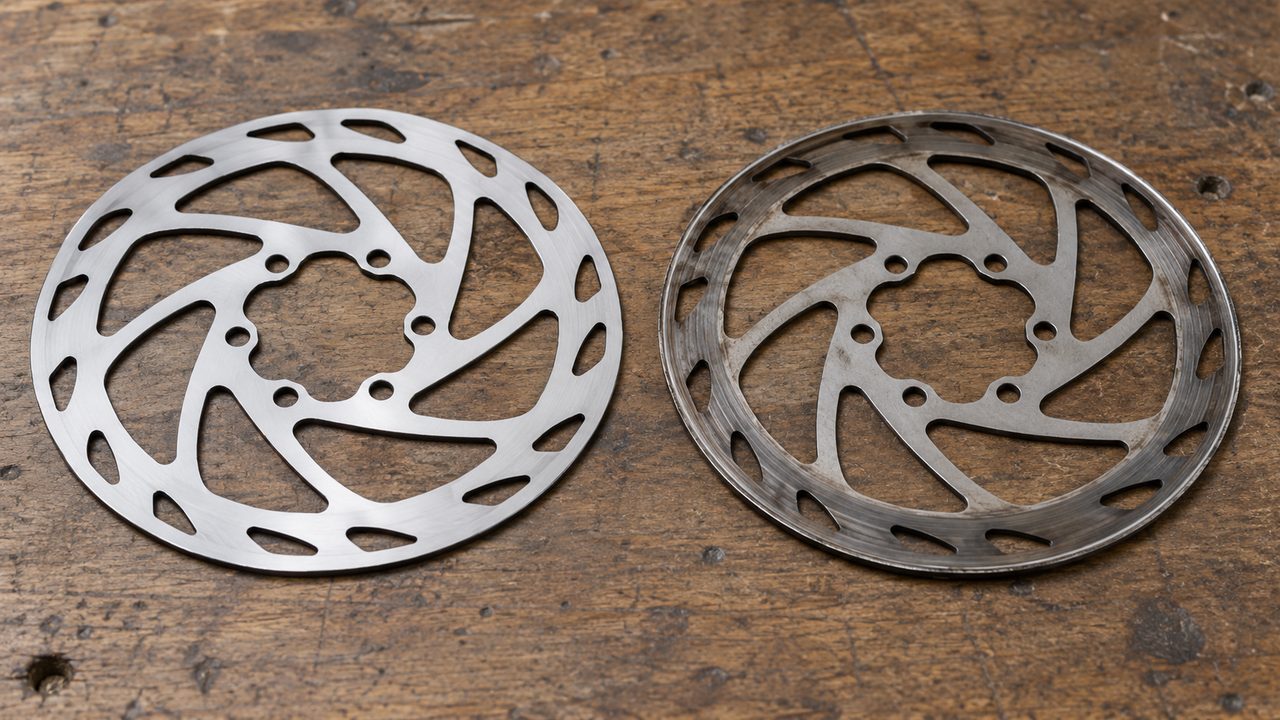
Rotor minimal thickness by maker
Measure the braking observe at its thinnest level with a caliper or micrometer and examine it with the determine printed on the rotor or on this desk.
Maker and rotor
Substitute when
Supply
Shimano (MTB and street hydraulic disc brake supplier’s manuals checked)
1.5 mm or much less, or when the aluminum layer reveals by means of
Shimano supplier’s manuals
SRAM 1.85 mm rotors (CenterLine, CenterLine X, Paceline, Paceline X)
Thinner than 1.55 mm
SRAM brake upkeep information and consumer handbook
SRAM 2 mm rotors (HS2)
Thinner than 1.7 mm
SRAM brake upkeep information and consumer handbook
Some other model
The minimal stamped on the rotor
The rotor itself
SRAM additionally tells riders to alter the rotor after they change pad compound.
Rub after new pads
New pads are thicker than worn ones, so the pistons should go all the best way again first; run the piston reset, then pump the lever till the pads firmly contact the rotor. A faint tick on new pads usually fades after bed-in. Shimano’s process: experience at reasonable pace, brake to strolling tempo with one brake at a time, and repeat not less than 20 occasions for every brake. SRAM says “each time you put in new brake pads and rotors, bed-in should be repeated.” To guage when the following set is due, our brake pad put on calculator estimates an inspection level from mileage, circumstances and terrain.
Rub solely when sizzling
A rotor that runs clear within the workshop and rubs after an extended descent is shifting out of true because it heats up, and the bigger 180, 203 and 220 mm sizes are essentially the most susceptible to warping (Shimano).
If the rub disappears as soon as the rotor cools, the rotor is ok. Brake tougher for shorter spells as a substitute of dragging the brake the entire approach down.
If the rub stays after the rotor cools, the warmth bent it. True it or exchange it, and examine its thickness whereas it’s off.
Rub solely when standing, sprinting or cornering
Quiet within the stand however rubbing underneath load means one thing strikes. Examine on this order:
The axle. A thru-axle under its torque, or a fast launch that isn’t firmly closed, lets the hub shift.
Hub bearings. Rock the wheel facet to facet. Any knock is play that lets the rotor transfer.
Rotor bolts or lockring. A free rotor rocks on the hub.
Wheel and body flex. A light-weight brush on a giant rotor in a tough nook, with each bolt tight, is the wheel and body flexing. Low spoke stress provides flex; see the way to true a motorcycle wheel.
Hydraulic vs mechanical: why they rub otherwise
Hydraulic disc
Mechanical (cable) disc
What strikes the pads
Fluid pushes pistons on each side (most designs)
The cable strikes one arm; on most single-arm calipers solely the outer pad strikes
Pad put on adjustment
Computerized: the pistons creep out as pads put on
Handbook: pad adjusters on two-knob calipers; a full reset on single-adjuster calipers
Standard rub trigger
Caliper off-center, sticky piston, pistons pushed out with the wheel off
Interior pad set too shut, caliper off-center, adjusters not reset for brand new pads
Centering methodology
Squeeze the lever and tighten the bolts
Set the pads by adjuster, then cosy the bolts (steps above)
When to cease using
Gentle rub you hear solely in a workstand, with the wheel spinning freely, can wait. Cease using and repair it, or see a store, if:
The rotor is at or under its minimal thickness: 1.5 mm for Shimano, 1.55 mm or 1.7 mm for SRAM, or the determine stamped on it. Shimano warns that such a rotor “might break.”
The rotor is cracked or deformed. Shimano’s instruction is to switch it.
The pads are all the way down to 0.5 mm of friction materials (Shimano) or 3 mm whole with the backing plate (SRAM).
Oil, grease or brake fluid has reached the pads or rotor, or a hose or caliper is leaking. Shimano says to not use the brakes with oil leaking.
The wheel slows to a cease by itself whenever you spin it, or the brake gained’t let go after you launch the lever. That’s drag; see bike brakes that gained’t launch.
A caliper bolt, rotor bolt or axle is free.
The lever pulls additional than typical or feels mushy for the reason that rub began.
Questions riders ask
Is a bit disc brake rub regular?
Sure, inside limits. Park Device says “It’s regular to have some lateral motion in your rotor because it spins,” and treats a rotor as straight sufficient as soon as it stops rubbing the pads. A faint tick whenever you spin the wheel by hand is ok. Rub you possibly can hear whereas using wears the pads and slows you, so heart the caliper or true the rotor.
Why does my disc brake rub after I took the wheel off?
The axle didn’t seat in the identical place, or the lever bought squeezed with the wheel out. Reseat the wheel, then push the pistons again if the rotor gained’t match between the pads.
Can I true a rotor whereas it’s on the bike?
Sure. Use the pads as your gauge and a rotor truing fork, as within the truing steps.
Will disc brake rub put on out my rotor?
Gentle rub wears the pads first. Regular rub provides warmth on each experience, and a rotor that runs sizzling for lengthy spells can bend, so a rub you ignore can turn into a bent rotor. Examine the rotor towards its minimal thickness everytime you exchange pads.
Sources
Park Device. Hydraulic Disc Brake Alignment (accessed October 15, 2026). Wheel seating with downward strain, “regular to have some lateral motion”, lever-squeeze centering, fine-tune by pushing the caliper within the path of the rub, no added washers, mount dealing with.
Park Device. Mechanical Disc Brake Alignment (accessed October 15, 2026). Single arm strikes the outer pad; inner-adjuster-only and inner-and-outer-adjuster procedures; single-adjuster calipers reset as pads put on; pad adjusters, not the barrel adjuster; about 6 Nm and 4 Nm.
Park Device. Disc Brake Rotor Truing (accessed October 15, 2026). Enterprise-card and 0.2 mm instance requirements, “not rubbing” commonplace, truing on the bike with the pads as reference, gentle effort first, two-piece rotors on the outer perimeter, exchange if no enchancment or badly bent.
Park Device. Disc Brake Pad Elimination and Set up (accessed October 15, 2026). Retract pistons earlier than new pads, pump the lever till the pads contact the rotor.
Park Device movies: Tips on how to Align a Hydraulic Disc Brake on a Bike and Tips on how to True a Bicycle Disc Brake Rotor, YouTube (titles and writer confirmed by oEmbed, October 15, 2026).
Shimano. Seller’s Handbook DM-MADBR01-06, Hydraulic Disc Brake (MTB) (learn October 15, 2026). Rotor 1.5 mm or much less or aluminum seen, pads 0.5 mm, bigger rotors warp extra, mounting boss and dropout not parallel, fast launch on the rotor facet, pad spacers, piston push-back and caliper piston upkeep, oil funnel, bleed screws, 6-8 N·m, bed-in 20 occasions, oil on pads or rotor, oil leaks.
Shimano. Seller’s Handbook DM-RADBR01-11, Hydraulic Disc Brake / Twin Management Lever (street) (learn October 15, 2026). Similar 1.5 mm rotor and 0.5 mm pad limits and 6-8 N·m caliper fixing screws for street calipers.
SRAM. Brake Upkeep Information (accessed October 15, 2026). Rotor minimums 1.55 mm (1.85 mm rotors) and 1.7 mm (2 mm rotors) with rotor names, pads at 3 mm whole, bed-in after new pads and rotors.
SRAM. MTB Disc Brakes and Shifters Person Handbook, 95-5018-019-100 Rev M (2023, learn October 15, 2026). Caliper centering (squeeze 3 times and maintain), 9.5 N·m caliper bolts, rotor put on limits, change rotors with pad compound.
SRAM. Disc Brake Pads Person Handbook, 95-5018-018-000 Rev A (learn October 15, 2026). Pads under 3 mm whole, rotor under 1.55 mm, pushing the pistons flush with a flat blade screwdriver between the pads.