Most runners I discuss to are utilizing HRV improper.
They get up to a crimson readiness rating, skip the exercise on the schedule, and do the identical factor the subsequent time the rating is crimson.
Three weeks later they surprise why race day felt so laborious.
So why is that this the improper method and the way do you have to be utilizing your HRV rating?
To offer an evidence-based reply, let’s take a look at the research-backed sensible recommendation on…
What HRV measures in your physique and why a swing of 10 to twenty% from in the future to the subsequent is regular
Why one morning’s HRV studying advised researchers nearly nothing a few runner’s 10K, whereas the weekly common tracked it carefully
The 4 HRV developments that deserve a change in your coaching, together with the one the place a inexperienced rating hides fatigue
A choice desk for when a low HRV ought to change your exercise and when to run it as deliberate
Find out how to measure HRV so the pattern means one thing
What Does HRV Really Measure?
Coronary heart price variability is the change in time from one heartbeat to the subsequent, measured in milliseconds.
A coronary heart beating 60 occasions a minute doesn’t beat precisely as soon as a second.
One hole between beats lasts 0.95 seconds, the subsequent lasts 1.05 seconds, and HRV is the dimensions of these variations.
Most watches and rings report a model of HRV known as RMSSD, which is the common beat-to-beat distinction throughout the studying.
These variations come out of your parasympathetic nervous system, the department that slows your coronary heart and runs digestion, sleep and restoration.
The parasympathetic system slows your coronary heart via the vagus nerve, and it does so inconsistently, rushing the center barely as you breathe in and slowing it as you breathe out.
The extra lively your parasympathetic system is, the bigger these beat-to-beat variations get and the upper your HRV reads.
Stress of any type does the other.
A tough exercise, a poor night time of sleep, a chilly or a tough week at work all activate your sympathetic nervous system, the battle or flight department.
When the sympathetic system is extra lively, your HRV drops.
A evaluation of coronary heart price monitoring in athletes reported {that a} single laborious session lowers HRV for twenty-four to 48 hours.
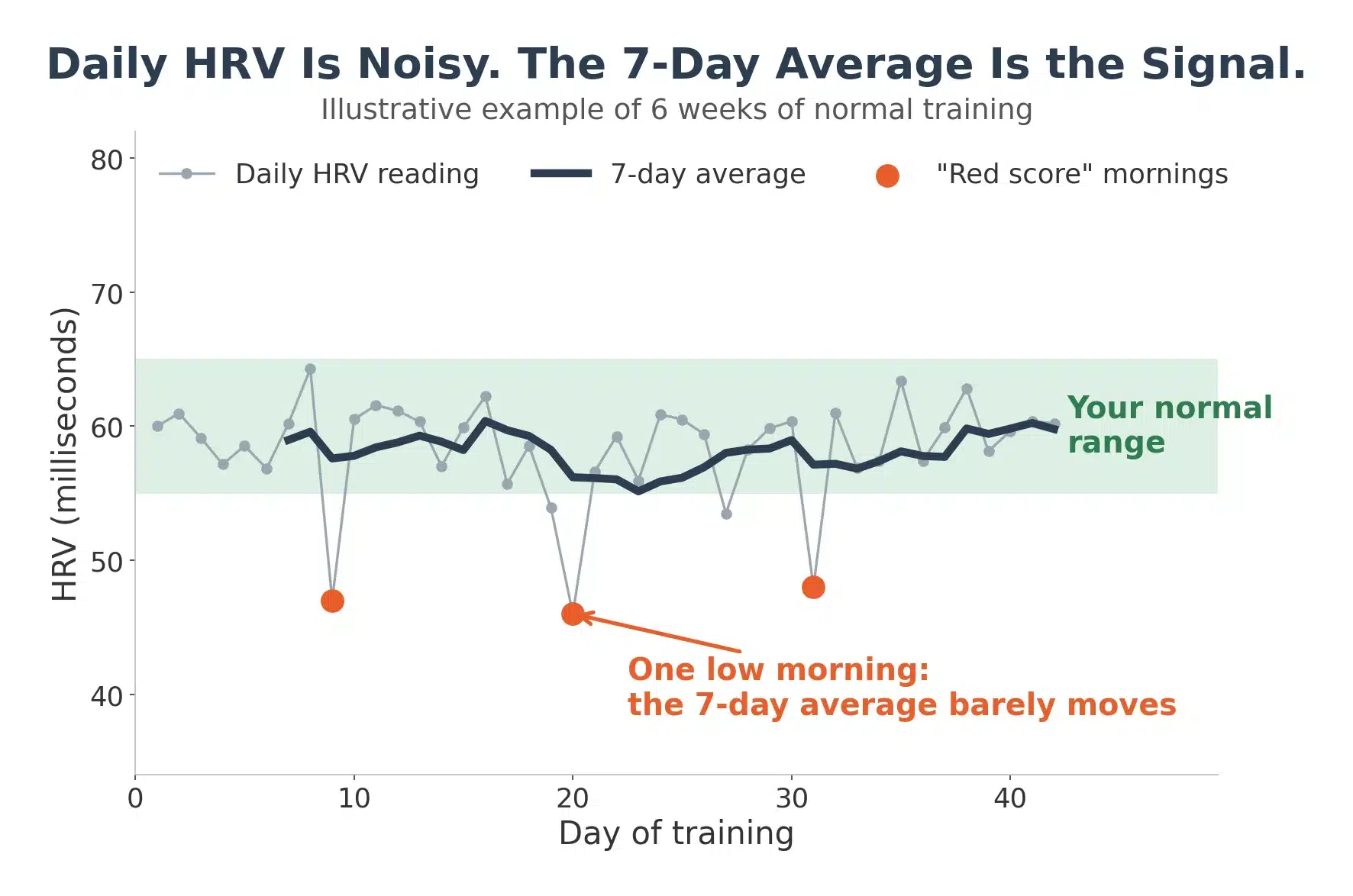
The identical evaluation discovered that HRV swings 10 to twenty% from in the future to the subsequent in athletes whose coaching goes effectively.
Which means a runner who averages 60 milliseconds can learn 50 one morning and 70 the subsequent with nothing improper.
HRV additionally differs broadly from one individual to a different, so the one helpful comparability is in opposition to your personal numbers from the previous few weeks.
Why Does Your Readiness Rating Get HRV Incorrect?
First off, it’s not as a result of your watch isn’t measuring your HRV precisely.
A 2024 research measuring the Oura ring vs. a medical-grade ECG discovered that in a single day HRV readings solely differed from the ECG by a mean of two.5 to three.8 milliseconds. So, your watch is probably going studying accurately.
Researchers have additionally examined how a lot in the future of that correct knowledge tells you.
A 2013 research adopted 10 runners via 9 weeks of coaching and in contrast the change in every runner’s HRV with the change of their 10K time.
A single morning’s HRV studying scored 0.17 out of 1 for monitoring how a lot a runner’s 10K improved, whereas the weekly common of the identical readings scored 0.76.
Which means the identical knowledge went from ineffective to helpful when the researchers stopped in the future at a time.
Your readiness rating does the other, as a result of it grades you on the latest night time.
A crimson rating the morning after a tough exercise is the 24 to 48 hour drop described above, which is your physique responding to the coaching the way in which it ought to.
Issues that don’t have anything to do with coaching transfer a single night time simply as a lot.
A 2026 evaluation tracked alcohol and in a single day HRV in 20,968 wearable customers throughout 5.1 million days.
One drink greater than an individual’s ordinary quantity lowered in a single day HRV by 3.3 milliseconds in males and three.8 milliseconds in ladies.
The identical further drink raised in a single day resting coronary heart price by 2.4 to 2.8 beats per minute.
A glass of wine with dinner, a late meal or an evening in a resort mattress can flip your rating crimson.
None of them say something about whether or not your legs are prepared for Tuesday’s tempo run.
Which HRV Developments Really Matter?
So, if you will use HRV, it’s good to take a look at developments and never simply one-off scores.
Listed below are 4 HRV patterns with analysis behind them and why it’s good to take a look at them over weeks, not simply days.
Is your 7-day common falling whereas your resting coronary heart price climbs?
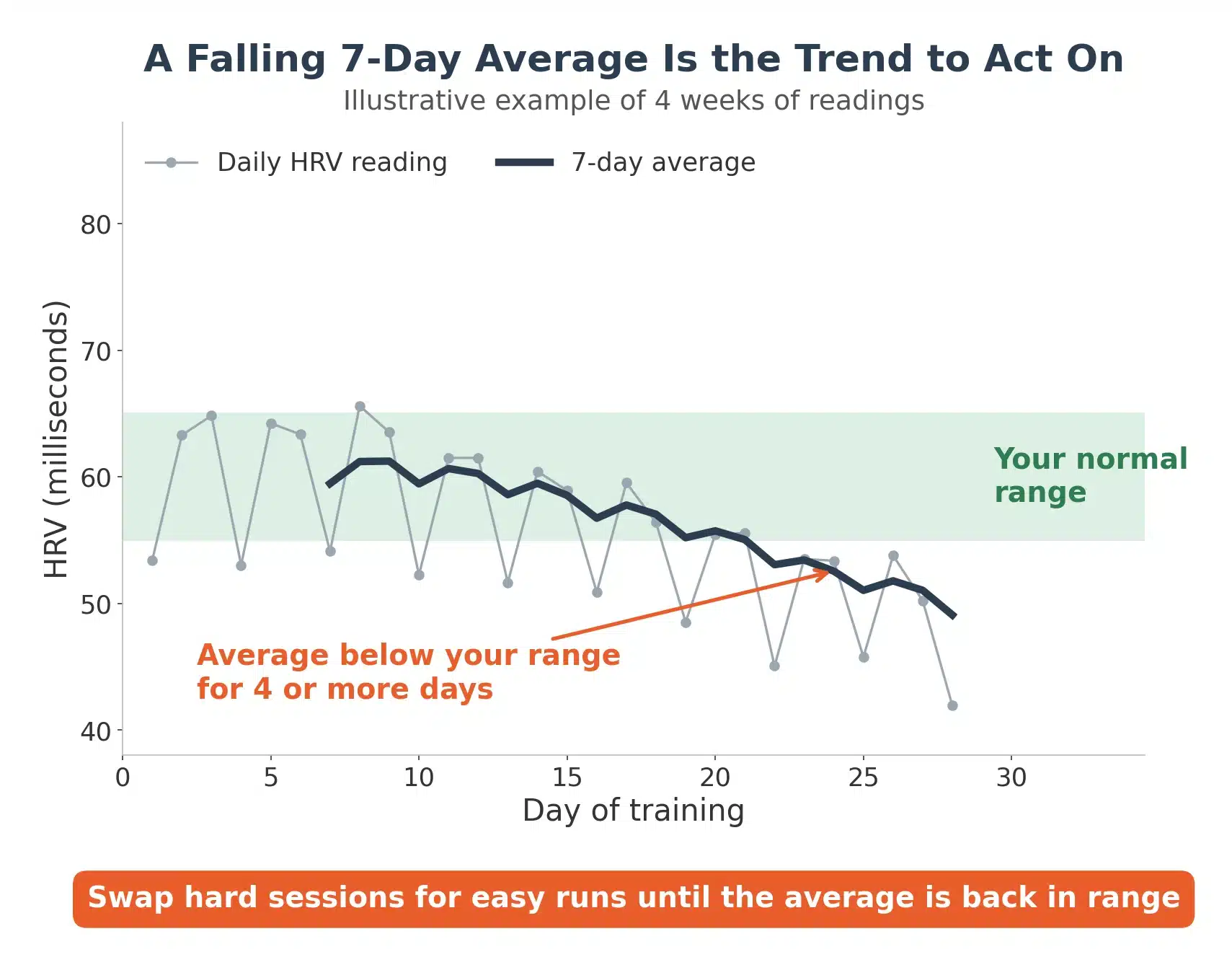
A 7-day HRV common that retains dropping whereas your resting coronary heart price rises is the sample that got here earlier than a failed race within the analysis.
A case comparability tracked two elite triathletes each morning for roughly 10 weeks earlier than a significant race.
The primary athlete’s 7-day common held regular for the complete 10 weeks, and he raced effectively.
The second athlete’s 7-day common fell week after week whereas her resting coronary heart price climbed about 3 beats per minute every week.
She didn’t end the race, and he or she wanted an prolonged break from coaching afterward.
Act when your 7-day common sits beneath your regular vary for 4 or extra days and your resting coronary heart price is up.
Exchange your laborious periods with straightforward operating till the common returns to your vary.
A slide that continues via a full week of straightforward operating is the purpose to learn up on the opposite signs of overtraining in runners.
Have your day-to-day swings flattened out?
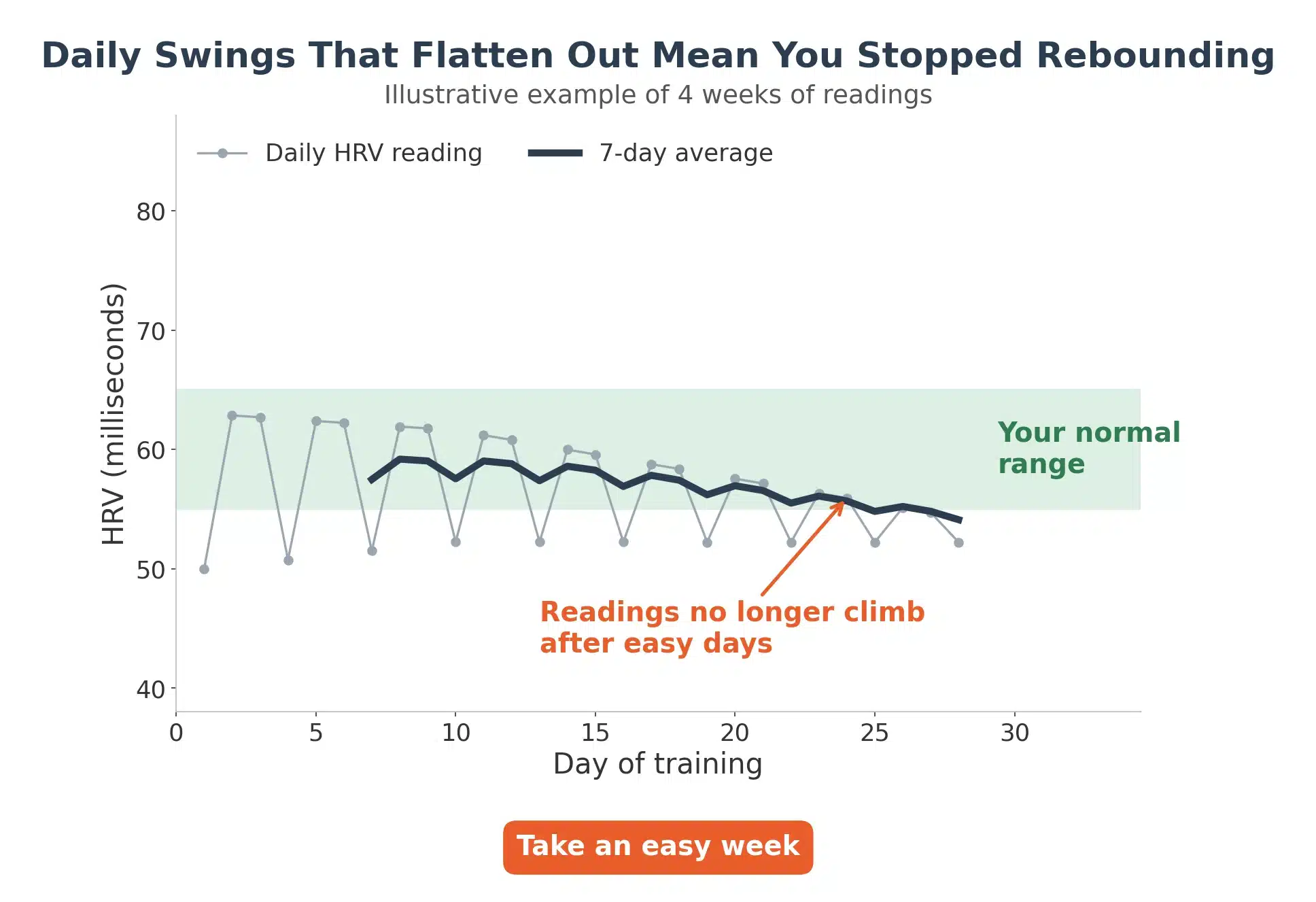
Wholesome HRV bounces, dropping the morning after a tough session and climbing again after a straightforward day.
In the identical case comparability, the overreached triathlete’s each day swings shrank steadily as her fatigue constructed.
Her readings stopped rebounding after straightforward days and settled right into a flat line on the low finish of her vary.
The athlete who raced effectively stored the complete sample of dips and rebounds all through his coaching.
In case your readings have stopped rising after straightforward days, deal with it the identical approach as a falling common and take a straightforward week.
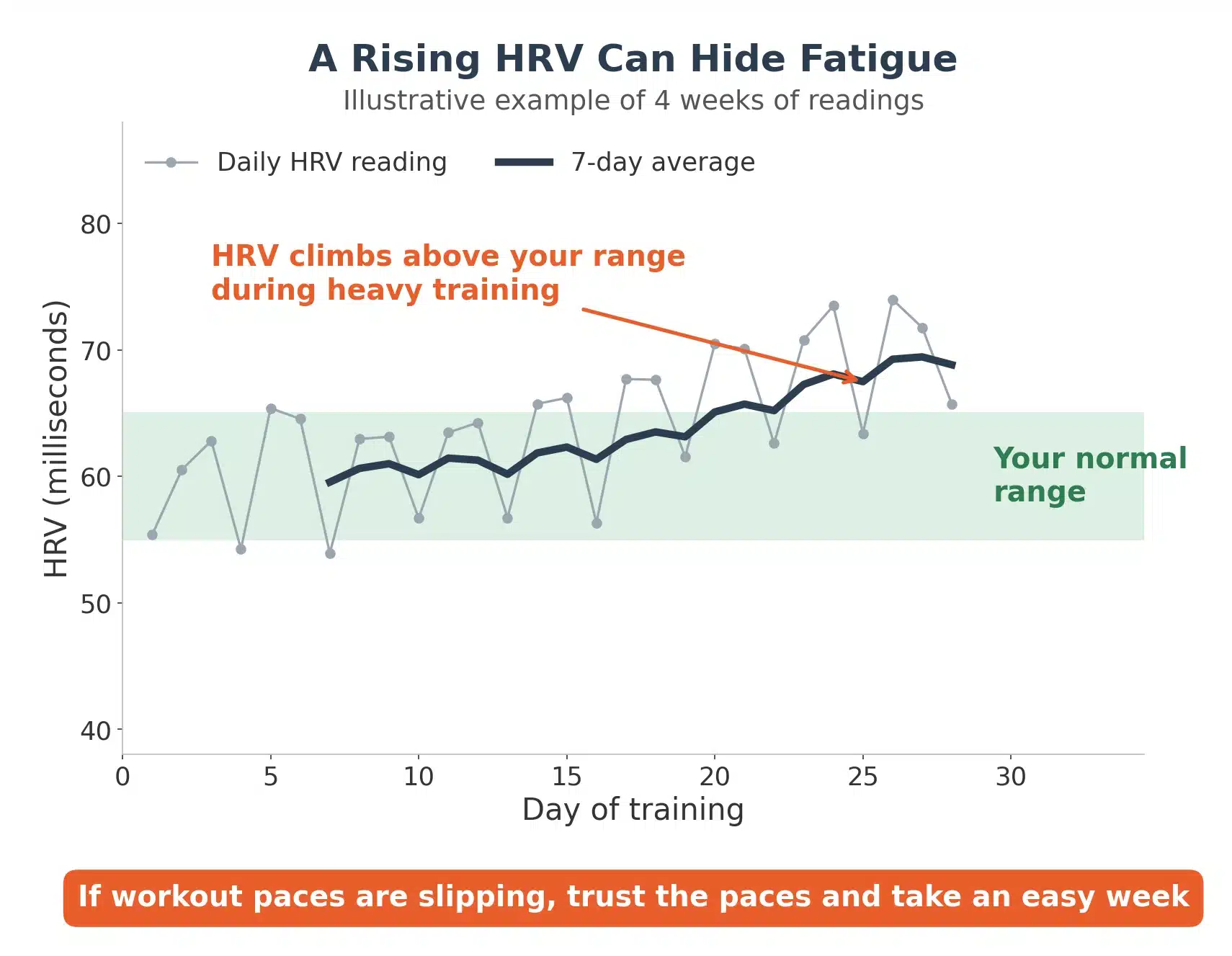
Is your HRV rising whereas your operating will get worse?
A excessive HRV doesn’t show you’re absorbing your coaching.
A 2020 research took 11 runners averaging 29 miles, or 46 kilometers, every week and almost doubled their coaching load for two weeks.
Their resting HRV went up throughout these 2 weeks.
Their common 5K time trial slowed from 19:35 to 19:57, and so they rated the coaching as tougher to tolerate.
After a 10-day taper their HRV got here again down and their 5K time dropped to 19:09.
Which means every week of inexperienced scores throughout your heaviest coaching can sit on high of actual fatigue.
When your HRV is excessive and your exercise paces are slipping on the similar effort, consider the paces.
Does HRV drop throughout your taper?
HRV in elite endurance athletes usually falls within the weeks earlier than a significant competitors whereas their efficiency retains bettering, based on the evaluation cited earlier.
That proof comes from elite athletes, and no one has run the identical research on on a regular basis marathoners.
It’s nonetheless sufficient cause to depart your taper alone when race-week nerves, journey and a decrease HRV all present up collectively.
When Ought to a Low HRV Change Your Exercise?
A low HRV ought to change your exercise solely when your resting coronary heart price and the way you are feeling agree with it.
A 2025 trial examined this in 28 skilled cyclists over 31 days.
One group had their laborious, straightforward and relaxation days set by HRV alone, and their 20-minute energy didn’t change by a measurable quantity.
One other group had their days set by HRV, resting coronary heart price and a morning score of their sleep, fatigue, soreness and stress.
That group raised their 20-minute energy from 261 watts to 285 watts, a achieve of about 9%.
The teams have been small at 8 riders every, so deal with the 9% as a course greater than a exact quantity.
Right here is the right way to put HRV, resting coronary heart price and the way you are feeling collectively on a given morning.
What you see
What it often means
What to do
One low studying and you’re feeling advantageous
Regular each day swing or yesterday’s laborious session
Run the exercise as deliberate
One low studying and you’re feeling awful
A brief night time, a drink, a chilly beginning or life stress
Jog the primary 10 minutes of the warm-up and resolve then
7-day common beneath your vary for 4 or extra days and you’re feeling advantageous
Coaching load is constructing
Run the exercise and verify your resting coronary heart price and exercise paces
7-day common beneath your vary, resting coronary heart price up and you’re feeling flat
You aren’t recovering between periods
Swap laborious periods for simple runs till the common is again in vary
HRV excessive however exercise paces slipping
Fatigue the rating is hiding
Take a straightforward week
HRV dips throughout your taper
Widespread earlier than a race
Hold the taper as written
The ten-minute warm-up within the second row is roofed step-by-step within the information on whether or not to skip a exercise if you’re drained.
Solely two rows within the desk take laborious periods away, and neither one is triggered by a single low studying.
How Ought to You Measure HRV So the Development Means One thing?
A pattern is barely nearly as good because the consistency of the readings behind it, so measure below the identical situations each time.
Use one technique and keep it up. Put on your watch or ring to mattress each night time, or take a 1 to 2 minute studying every morning proper after you get up.
Get sufficient readings. Researchers who monitor elite athletes advocate a minimal of three readings every week to construct a weekly common, and each day readings are the goal.
Have a look at the 7-day common in opposition to your personal baseline. Most apps present this on a separate pattern display screen, plotted in opposition to a shaded band that marks your regular vary.
Give a brand new gadget 4 weeks earlier than you act on it. Your regular vary can’t be drawn till the app has a few month of your readings.
Write down the apparent causes. Be aware alcohol, late meals, journey and sickness so a single low night time has a proof earlier than it worries you.
If checking a pattern display screen each morning is greater than you’ll sustain with, ignore the each day rating and take a look at your 7-day common as soon as every week on the identical day.
Examine Your 7-Day HRV Development As soon as a Week and Run the Exercises in Between
Your HRV studying is correct, and in the future of it says nearly nothing about your health or your readiness to coach.
The weekly common in contrast with your personal regular vary is what the analysis helps.
Change your coaching when that common stays low for 4 or extra days and your resting coronary heart price and your legs agree with it.
On each different morning, together with the crimson ones, run the exercise in your schedule.
Begin this week by discovering the 7-day HRV display screen in your app and selecting in the future to verify it.
HRV pattern
What the analysis discovered
What to do
One low morning studying
A single day’s HRV scored 0.17 out of 1 for monitoring 10K enchancment. Day by day swings of 10 to twenty% are regular.
Run the deliberate exercise.
7-day common inside your regular vary
Runners who scheduled laborious days this fashion ran 3000 meters 2.1% quicker on 13 laborious periods in 8 weeks.
Do your laborious periods as scheduled.
7-day common falling with resting coronary heart price rising
An elite triathlete with this sample for 10 weeks didn’t end her race.
Exchange laborious periods with straightforward runs till the common is again in vary.
HRV rising whereas paces slip
Runners who almost doubled their coaching for two weeks noticed HRV rise whereas their 5K slowed by 22 seconds.
Belief the paces and take a straightforward week.
HRV dip in the course of the taper
HRV usually falls in elite athletes earlier than competitors whereas efficiency improves.
Hold the taper as written.