
You will have run the identical marathon construct 3 times, hit your mileage, nailed your exercises, and nonetheless crossed the road on the identical end time.
In some unspecified time in the future regular, progressive coaching stops shifting the needle.
Useful overreaching is the deliberate manner out of that rut, and it is among the most misunderstood instruments in endurance coaching.
Accomplished proper, a brief block of concentrated overload adopted by actual restoration pushes your health above the place it sat earlier than.
Accomplished fallacious, the identical block digs a gap you spend weeks climbing out of.
The hole between a breakthrough and a wrecked season typically comes right down to a single variable: how lengthy you get better after the arduous block.
Here’s what you’ll be taught:
What useful overreaching truly is and the way it builds health
How useful overreaching differs from its non-functional cousin
The signs that let you know which aspect of the road you’re on
The place overreaching ends and overtraining begins
How elite coaches program deliberate overload
The right way to run a protected dig cycle in your individual coaching
What Is Useful Overreaching?
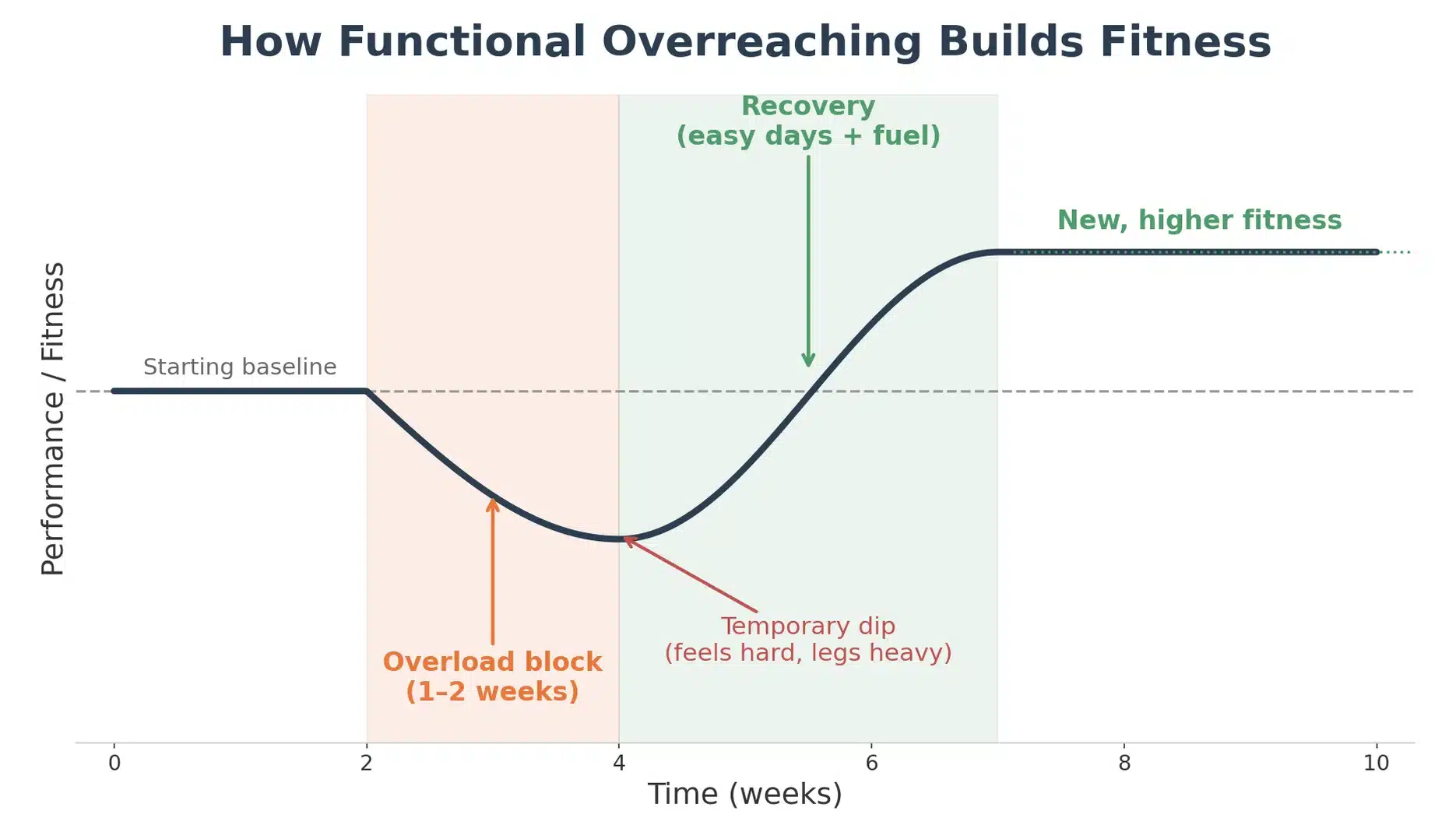
Useful overreaching is a deliberate, short-term spike in coaching load that causes a short lived dip in efficiency, adopted by a rebound to the next stage than earlier than.
Your physique adapts to arduous coaching via a course of known as supercompensation.
After a tough block, efficiency drops throughout restoration, then climbs above your previous baseline as soon as you’re rested.
Progressive coaching depends on repeating that cycle in small doses over months.
Skilled runners finally hit a ceiling the place predictable, regular stress stops producing new positive aspects.
One managed trial discovered that 12 straight days of maximal coaching adopted by 6 days of relaxation raised peak energy output, whereas the group that skilled the identical quantity with relaxation days inbuilt noticed no change.
The overload group felt worse in the course of the arduous days and their efficiency sagged.
After six days of restoration, they jumped previous a stage the evenly-spaced group by no means reached.
That rebound is useful overreaching in a single sentence: quick overload, actual restoration, larger health.
Useful vs. Non-Useful Overreaching: What Is the Distinction?
The distinction between useful and non-functional overreaching is just not the coaching. It’s the restoration timeline and the end result.
Useful overreaching produces a efficiency dip that lasts days to about two weeks, and you then come again stronger.
Non-functional overreaching produces the identical dip, however restoration stretches into weeks and no rebound arrives.
In line with the joint consensus assertion from the European School of Sport Science and the American School of Sports activities Drugs, useful overreaching restores and improves efficiency inside days to weeks, whereas non-functional overreaching stalls efficiency for weeks with no acquire above baseline.
Each begin the identical manner, with a runner coaching past their regular load on goal.
The fork seems afterward, and it’s determined nearly totally by how effectively you get better.
Useful overreaching is a two-week detour that ends in a health leap.
Non-functional overreaching is a multi-week setback that ends the place you began, or decrease.
This is the reason the restoration block is just not optionally available padding after the arduous work.
It’s the half of the equation that turns overload into adaptation as a substitute of exhaustion.
RunnersConnect Bonus
Obtain your FREE Marathon Restoration Schedule for Runners.
It’s a PDF exhibiting how you can get better accurately within the 3 weeks put up marathon, plus our cross coaching information with over 20 pattern exercises for the commonest cross coaching sorts
GET MY GUIDE
What Are the Signs of Overreaching?
The signs of overreaching are straightforward to really feel however arduous to interpret, as a result of early useful overreaching seems to be quite a bit like the beginning of bother.
Throughout a deliberate overload block you must anticipate heavy legs, larger perceived effort at regular paces, and short-lived drops in exercise high quality.
These indicators are procedural. They let you know the stimulus is large enough to matter.
The warning indicators sit one layer deeper and level towards the non-functional aspect.
Resting coronary heart charge: a morning studying greater than about 10 beats above your regular common, holding for a number of days
Sleep: damaged or shortened sleep lasting greater than three nights
Temper: irritability, flatness, or lack of want to coach past odd tiredness
Sickness: a lingering chilly, sore throat, or run-down feeling that won’t clear
The consensus analysis hyperlinks non-functional overreaching to precisely this cluster: extended fatigue, sleep disturbance, elevated resting coronary heart charge, sickness, and psychological stress.
One or two tough days inside a tough block is regular, however a stack of deeper signs that retains constructing is your cue to cease the block and get better.
The sensible rule is route, not any single studying.
Fatigue that plateaus after which lifts with relaxation is useful. Fatigue that retains climbing irrespective of how straightforward you run is just not.
Overreaching vs. Overtraining: The place Is the Line?
Overreaching and overtraining sit on the identical spectrum, separated by how lengthy the efficiency loss lasts.
Overreaching, useful or not, is measured in days to weeks.
Overtraining syndrome is measured in months.
The consensus definition treats overtraining syndrome as an excessive type of non-functional overreaching, with a efficiency drop lasting greater than two months and normally a set off past coaching load alone.
Consider it as three stops on one street.
Useful overreaching is the productive detour you propose for.
Non-functional overreaching is the fallacious flip you may nonetheless get better from in a number of weeks.
Overtraining syndrome is being misplaced for months.
Most runners by no means attain overtraining syndrome, as a result of it normally takes repeated non-functional episodes plus exterior stress like poor sleep, under-fueling, or life load.
Studying to learn the road between coaching arduous and overtraining is what retains a deliberate block on the productive aspect.
The aim is to go to useful overreaching on goal and go away earlier than it curdles into something worse.
How Do Elite Coaches Use Deliberate Overreaching?
Elite coaches use deliberate overreaching as a scheduled occasion, not a temper, putting concentrated overload weeks out from a aim race and guarding the restoration simply as fastidiously.
One coach described the purpose as ramping load to the sting of what an athlete can take in, then pulling again into restoration solely as soon as the stimulus is clearly sufficient.
Jerry Schumacher’s Medium Dig Cycle
Jerry Schumacher, head coach of the Bowerman Monitor Membership, builds round a precept his athletes summarize as power being velocity for distance runners.
Quite than layering depth onto straightforward quantity, his runners maintain persistently excessive mileage with few prolonged down durations.
His medium dig cycle is a 2 to three week stretch the place quantity and depth each rise by roughly 20 to 30 p.c.
Athletes run frequent doubles and stack threshold work alongside observe repetition, and so they report feeling overwhelmed up at paces they usually deal with with ease.
The safeguard is what follows: obligatory restoration after each dig cycle, monitored intently, so overload by no means drifts into non-functional territory.
Renato Canova’s Particular Block
Renato Canova has coached extra sub-2:05 marathoners than any coach in historical past, and his particular block is probably the most aggressive deliberate overload in marathon coaching.
A particular block pairs two demanding periods in at some point, morning and afternoon, with whole quantity reaching 45 to 50 kilometers.
Athletes preserve carbohydrate low between the 2 periods, pushing the physique to burn fats effectively whereas glycogen is depleted.
Canova reverses the same old order by beginning at marathon tempo and lengthening how lengthy that velocity may be held, relatively than including velocity to sluggish quantity later.
He locations particular blocks about 9, 6, and three weeks out, leaving room for the variation to floor earlier than the beginning line.
How Lengthy Ought to an Overreaching Block Final?
An overreaching block ought to final lengthy sufficient to drive adaptation and quick sufficient to get better from inside two weeks.
For many on a regular basis marathoners, which means a tighter window than the elite examples counsel.
Excessive mileage (70+ miles per week): 2 to three week blocks are manageable
Average mileage (50 to 70 miles per week): cap the concentrated overload at 1 to 2 weeks
Push for much longer and the danger of tipping from useful into non-functional overreaching rises sharply.
Restoration is the non-negotiable different half, and gasoline decides which final result you get.
If you’re going to dig a gap with coaching, you want the carbohydrate to climb again out.
Sleep is the opposite lever, and it does its heaviest lifting throughout and proper after the block.
A easy verify retains you sincere, the two-day rule: take two straightforward days after the block, then take a look at with a more durable session on day three.
Hit your paces and really feel robust, and restoration is on observe. Wrestle badly at regular effort, and also you want simpler days earlier than you load once more.
How Can You Safely Strive a Dig Cycle?
You may run a protected dig cycle by maintaining the overload modest, the timing deliberate, and the restoration aggressive.
Begin with the calendar.
Roughly 10 to 12 weeks earlier than your aim race, choose a ten to 14 day window the place work and life stress are low.
Then elevate the load in a managed manner relatively than abruptly.
Quantity: add 20 to 25 p.c to your regular week, so 60 miles turns into about 72 to 75
High quality: add one additional session, or lengthen your current exercises by 15 to twenty p.c
Count on: heavier legs and better effort at straightforward paces, which is the purpose, not an issue
Abort the block early when you see sickness signs, a resting coronary heart charge greater than 10 beats above regular, temper disturbance past coaching fatigue, or sleep disruption previous three nights.
A single-session model of Canova’s thought works effectively for non-elite runners.
Strive a 3-mile straightforward warm-up, 6 miles progressing from marathon tempo plus 30 seconds right down to marathon tempo, then 5x1km at 10K effort with 400m jog restoration, and a 2-mile cool-down.
For reference, that ending 10K effort is roughly 6:52 per mile or 4:16 per kilometer for a 45-minute 10K runner, adjusted to your individual paces.
When the block ends, minimize quantity by 40 to 50 p.c for a full week and run straightforward solely.
Prioritize sleep, elevate your carbohydrate consumption, and skip exercises totally throughout that week.
Check with a tempo run or a number of marathon-pace miles about 8 to 10 days after the block.
If these paces come at decrease effort than earlier than, supercompensation is doing its job and you’ll return to regular coaching.
Is Deliberate Overreaching Well worth the Danger?
Deliberate overreaching is definitely worth the threat for the skilled runner who has genuinely run out of street on regular development, and a poor guess for everybody else.
The upside is actual, since a well-run block can ship in two to 3 weeks what months of typical coaching couldn’t.
The margin can also be skinny, and the identical analysis group nonetheless debates whether or not forcing overreaching beats merely coaching arduous inside your restoration capability.
A evaluation of useful overreaching in endurance athletes notes that some athletes who overreach present dampened variations in contrast with those that full the identical coaching with fuller restoration between periods.
Coaches like Schumacher and Canova preserve utilizing the device as a result of, with exact monitoring, the payoff justifies the gamble.
When you’ve got constructed your mileage, sharpened your exercises, practiced race-specific efforts, and nonetheless stalled, a modest dig cycle would be the new stimulus your physique is ready for.
The runners who break via are hardly ever those who prepare hardest.
They’re those who load arduous on goal after which get better arduous sufficient to climb out stronger than they went in.